Maintenance pruning of problem branches
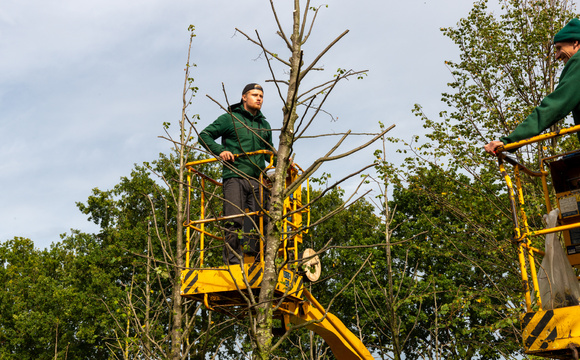

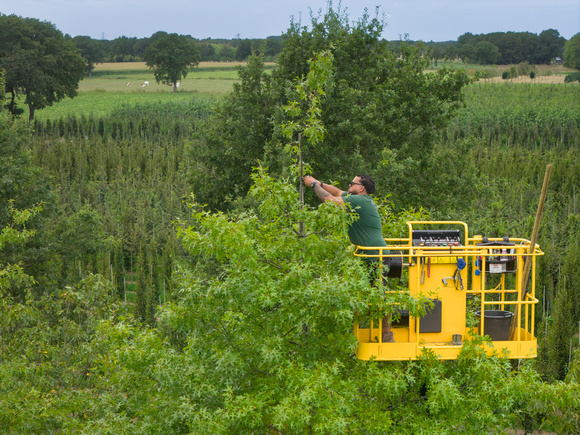
With maintenance pruning, the main consideration is which branches in the permanent canopy may cause problems in the future. Always begin a pruning session by removing the problem branches, such as dead and broken branches, suckers, included bark unions, watershoots, double leaders, etc. Only once these have been removed do you get a clear view of the overall balance of the crown. Once the clear stem height has been reached, pruning will decrease considerably. The problem branches that arise in the permanent crown will not quickly lead to problems and therefore form part of the tree’s eventual silhouette.
Broken and dead branches are always removed first, because they pose a risk if they break off and are a source of entry for disease. Broken branches are removed back to a lateral branch. With good-quality planting material, these branches will hardly occur. If there are nevertheless many dead branches in the crown, this may indicate a poor growing site or a lack of light due to overhanging trees.
These are upright-growing branches that compete with the leader and pose an increased risk of breaking out. Suckers should be removed as soon as possible, because they may start to compete with the tree’s central leader and thereby throw the crown out of balance. If removal is delayed for too long, the rapid growth may also result in large pruning wounds. Trees that readily produce suckers include beeches (Fagus), elms (Ulmus), maples (Acer), false acacias (Robinia) and planes (Platanus).
With an included bark union, the branch lies pressed against the trunk of the tree and grows in the same direction as the trunk. An included bark union can be recognised by its V-shaped branch angle. Between the trunk and an included bark union there is bark inclusion, which means that proper structural attachment is lacking. As the branch with an included bark union becomes older and therefore larger, the risk of failure increases. Whether the branch should be removed depends on the thickness of the branch, its attachment, and whether failure would pose a risk because of the tree’s position.
These are branches that arise when dormant buds or adventitious buds on the trunk or on thicker branches begin to grow and develop vigorously, often straight upwards. Watershoots develop under deteriorating growing conditions, after heavy pruning or following sudden exposure to light. Through these branches, the tree attempts to restore its lost leaf volume. Before these branches are pruned, the cause must first be addressed, otherwise pruning will lead to even more watershoots. When pruning, never remove all watershoots in a single pruning session, but do so in phases during the summer. Otherwise, the tree will respond by producing even more watershoots.
Two leaders arise side by side because two terminal buds develop at the same time, or because the terminal bud dies back and the upper two lateral buds develop instead. If this occurs within the temporary crown, one of the leaders should be removed to prevent problems in the future. When the leaders are oriented east-west, the eastern leader is removed because of the prevailing westerly winds. If the direction is north-south, the southern leader is removed because of the growth direction towards the light. If the double leader is in the permanent crown and is well attached - recognisable by a clear U-shape - it can often be retained and contributes to the characteristic development of the crown form. In the permanent phase, the tree’s own specific habit should be accepted, and it is undesirable to prune the crown in an unnatural way.
When two branches in a crown cross each other directly, they will start to rub against one another. Damage occurs at the point of contact, creating an entry point for diseases and pests. The branch growing furthest inwards will need to be removed wholly or partially in order to solve this problem. If rubbing branches have already been present for years and even tend to grow together, it is better not to intervene and to retain the branches. During maintenance pruning, shoots at the base of the trunk and on the clear stem are usually also removed. These branches should be removed as close as possible without damaging the trunk, leaving the smallest possible wound surface at the base of the shoot. The removal of these shoots is done for appearance, not to guide the tree towards a balanced crown structure. Another option is not to remove shoots at the base of the trunk completely, but to prune them into shape, for example as a hedge. This creates a different end image, which can already be consciously chosen in the planting plan. Lime trees in particular lend themselves well to such an application.