Pruning and pruning guide
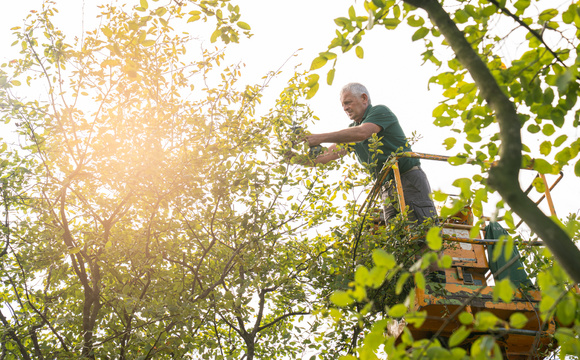

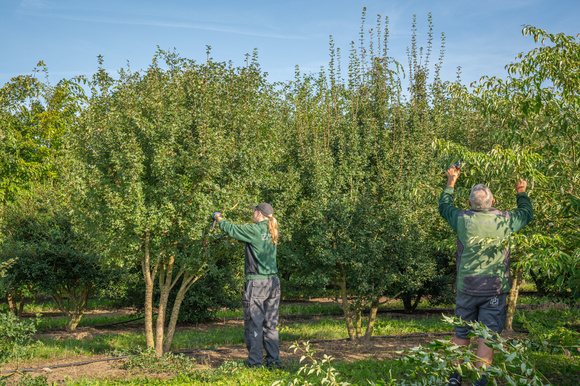
At our nursery, we guide a tree in its early years towards its ultimately desired form, for example a standard, feathered or multi-stemmed tree. By the time the trees leave the nursery for their final planting site, they have a balanced crown structure, meaning that all lateral branches are evenly developed in thickness and that no problem branches, such as watershoots or double leaders, are present in the crown. During the phase of formative pruning at the planting site, the tree is guided where necessary from its temporary crown towards its final clear stem height and definitive crown.
The desired end image determines which part of the canopy is temporary and which is permanent. For example: a standard tree with a total height of six metres and a clear stem height of two metres is planted in a public space. The eventual clear stem height must become four metres so as not to obstruct traffic. All lateral branches below those four metres form the temporary canopy and are removed over the course of formative pruning. All branches above four metres form the permanent canopy. Pruning in the temporary part is called formative pruning; pruning in the permanent part is maintenance pruning. A feathered tree that is allowed to grow freely in a lawn with branches down to the ground therefore has no temporary crown. All pruning on such a tree falls under maintenance pruning.
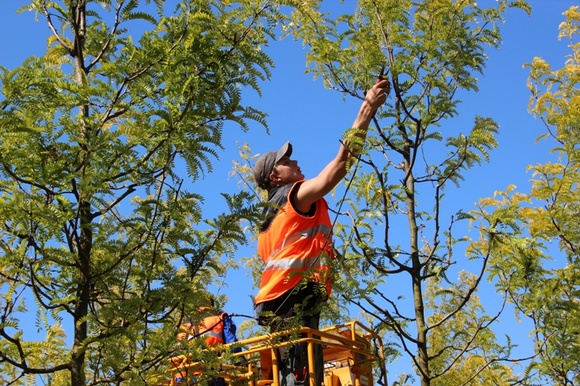
We begin formative pruning as soon as the tree is well established and producing normal shoot extension. Depending on the tree species, this will be in the second to fourth year after planting. Formative pruning should always be carried out in moderation, meaning that no large branches (thicker than a wrist) should be removed. If large branches do have to be pruned away, intervention has come too late and large pruning wounds will be created, weakening the tree. Such major interventions are rarely necessary with well-supplied, good-quality planting stock. The best time for pruning is in summer, because pruning wounds will heal and occlude most quickly at that time of year. Pruning in spring is strongly discouraged for species that bleed, such as maples (Acer), birches (Betula), hornbeams (Carpinus) and walnuts (Juglans). In this period, sap flow starts up and there is a risk that these trees will ‘bleed’ from the pruning wounds. With pruning in autumn, the tree has no opportunity to respond actively, and the pruning wounds become a point of entry for invading parasites. Plan formative pruning at intervals of once every two to three years after planting; then the interventions are rarely drastic.