Shaped trees
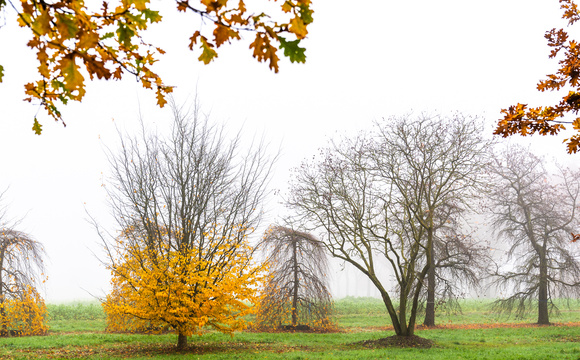

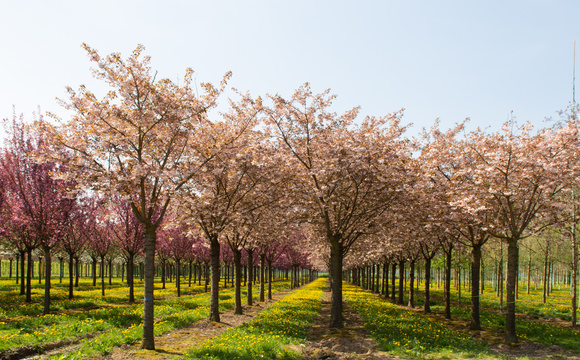
The standard tree is the most well-known tree form. It is characterised by a straight central leader or trunk, the lower part of which has been cleared of branches so that the crown begins higher up the trunk. Standard tree is in fact a very general term; even a weeping tree that has been crown raised falls under standard trees. A halfstem tree is a variation of the standard tree. The tree does have a clear trunk, but the crown begins lower than that of the standard tree. This form is often used in fruit growing, to make the fruit easier to pick. Standard trees are often planted along roads and avenues and are then managed towards a clear trunk height of at least 4.60 metres in connection with the required or desired clearance height for traffic. This means that branches at the bottom of the crown are removed annually until the correct height has been reached. At the nursery, standard trees are already prepared for their final location, meaning that part of the trunk is already cleared of branches. How large that clear section is depends on the overall height of the tree. To keep the tree in balance, the correct proportion is required (minimum clear trunk to crown height ratio 1:2).
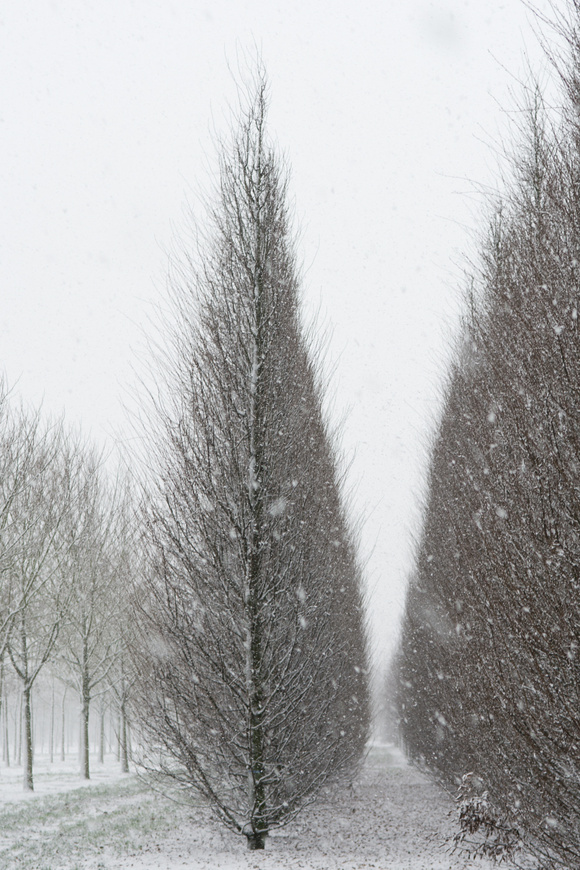
A feathered tree, like a standard tree, has a straight central leader or trunk. The difference from a standard tree is that this tree form is branched from the bottom to the top. A tree growing in isolation will naturally always develop as a feathered tree. Feathered trees have a beautiful, natural appearance and create a great deal of atmosphere and character. They are highly suitable as park trees, on country estates and in wide avenues. For some tree species, the branching is of great importance, as it can serve as natural protection against sun scorch on the bark.
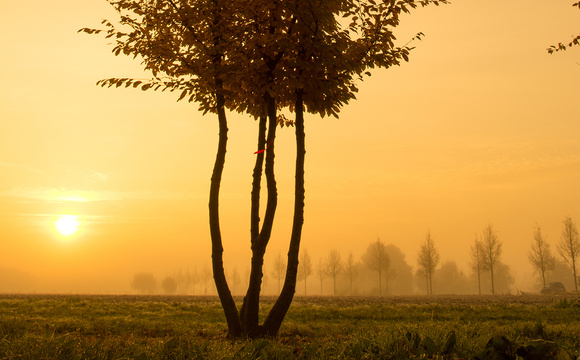
A multi-stemmed tree is - as the name suggests - a tree with multiple stems. There are two types of multi-stemmed trees, namely a multi-stemmed tree consisting of a single specimen and a multi-stemmed tree made up of several specimens planted together in one planting hole. A multi-stemmed tree consisting of a single specimen is much more sustainable than a combined planted specimen. No competition arises between the stems, resulting in a more natural and harmonious appearance that is maintained over time. Multi-stemmed trees create a great deal of atmosphere, intimacy and a sense of nature because the crown already begins at eye level and the structure of the multiple stems creates a sense of depth. These tree forms have countless applications, for example in parks and gardens, as climbing trees, as natural parasols or in planters. And in places where there is little space for multiple trees, multi-stemmed trees still provide the desired atmosphere. In recent years, multi-stemmed trees have also become popular for use in roof gardens. Because wind pressure is distributed across the multiple stems, the risk of damage is lower than with a tree consisting of a single central leader.
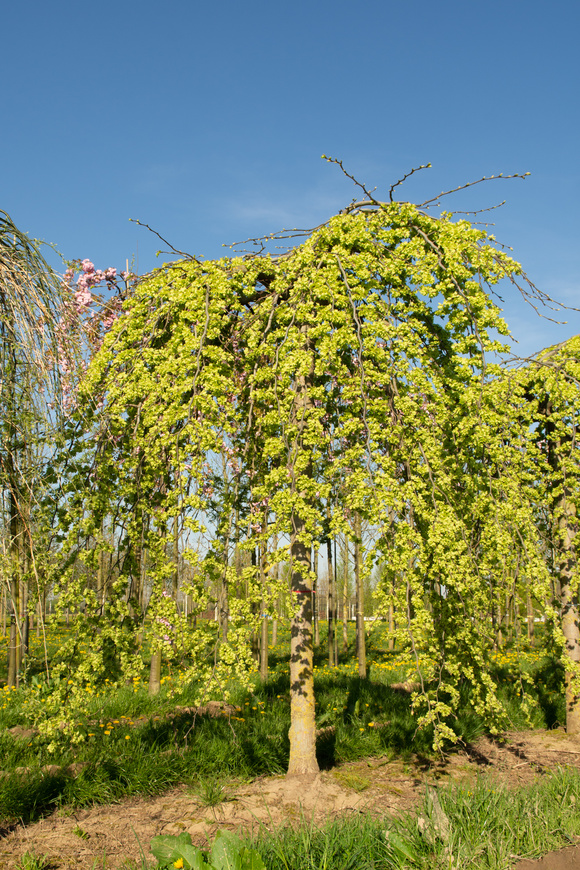
Weeping trees are distinctive tree forms with curved, pendulous branches that can reach down to the ground, creating what is almost a waterfall of foliage. Weeping forms also occur in the wild, although most species are selected varieties from seedlings that are usually propagated by grafting. In general, they need plenty of space to reach maturity. The character of a weeping tree is shown to best advantage when the tree is used as a specimen. Within weeping trees, a distinction can be made between grafted and non-grafted types. The weeping willow (Salix x sepulcralis ‘Chrysocoma’), for example, is a non-grafted type, while the black weeping beech (Fagus sylvatica ‘Black Swan’) is a grafted variety. Grafted weeping forms can be further divided into what are known as low-grafted and top-grafted trees. Low-grafted trees are grafted onto the rootstock just above ground level, while top-grafted trees are grafted onto the rootstock at the height where the crown begins.
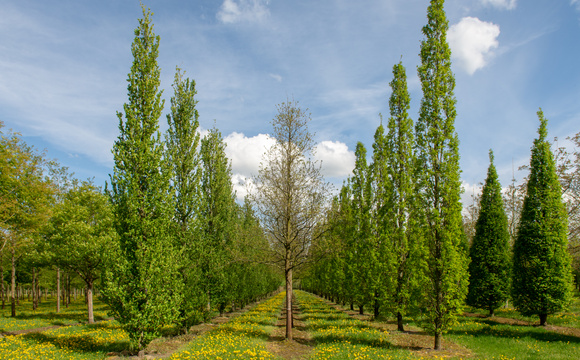
Columnar trees naturally have a slender, upright crown. In application, they are multifunctional, provided the right species is chosen. In polder landscapes, they can be used very effectively as windbreaks, in which case they may be robust trees that become broader with age, such as the columnar poplar Populus nigra ‘Italica’. In narrow streets, columnar trees are used when there is too little space for other tree forms, for example the columnar elm Ulmus ‘Columella’ or Liriodendron tulipifera ‘Fastigiata’. In such cases, species must be chosen that retain their narrow crown shape, or budget must be made available for proper tree management. When columnar trees are used to create an architecturally stately and formal appearance, such as in cemeteries, it is also important to choose species that do not start to spread with age.
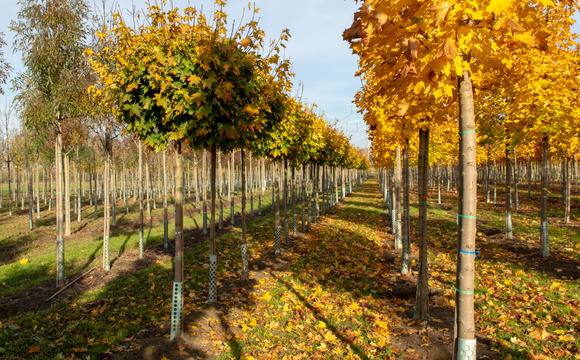
Globe trees are tree species that do not naturally have a central leader and therefore form a rounded crown. These trees are always top-grafted onto a rootstock with a stem height of between 1.80 and 2.40 metres. If the rootstock is lower than 1.80 metres, this is referred to as a half-standard globe form. Examples include the globe catalpa, Catalpa bignonioides ‘Nana’, and the beautiful Acer platanoides ‘Globosum’ (see image). The form of these top-grafted trees often most closely resembles a pollard tree, with a dense crown that creates a great deal of privacy.
To provide landscape designers with a practical tool for selecting the right tree, we launched TreeEbb. This instrument supports the selection of the right tree species during the design process. It also shows the performance that can be expected from trees in the long term. By creating a mood board, the final species selection can be presented to the client.
The selection criteria are based on the use of filters such as size, soil type, climate, growth rate or biodiversity value. It also indicates whether factors such as root damage to paving or the effect of road salt may play a role, thereby helping to prevent root problems or poor tree adaptation. It also provides guidelines for crown width, root volume and maintenance requirements.
TreeEbb contains a very wide range of species. It is not an up-to-date stock list of our nursery, but a broad overview of generally available species. By showing this vast diversity of species, we encourage both wider application to reduce monocultures and the risk of tree diseases, and a strategy for climate-adaptive design.
TreeEbb tree selection tool