Topiary trees
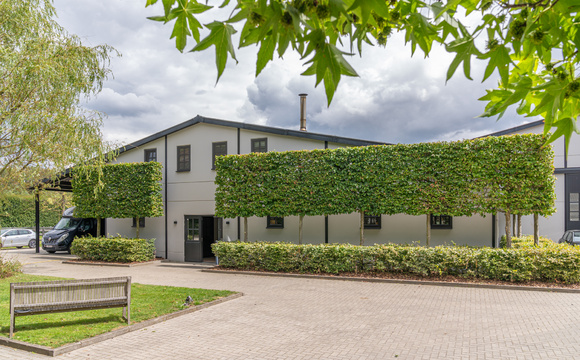

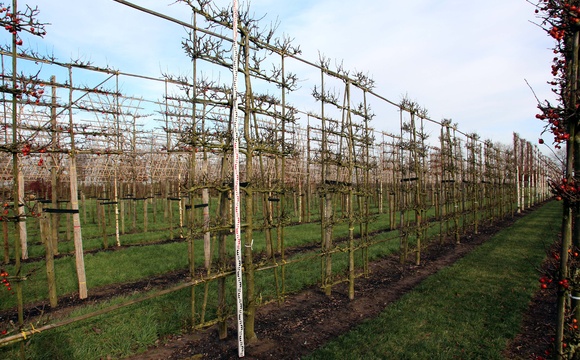
The difference between tree forms and topiary trees lies in the fact that the former refers to the tree’s natural shape. A tree form could therefore be a columnar tree. Topiary trees, on the other hand, are shaped through intensive pruning. An example might be a espalier pear tree, which is regularly pruned and trained along an espalier trellis.
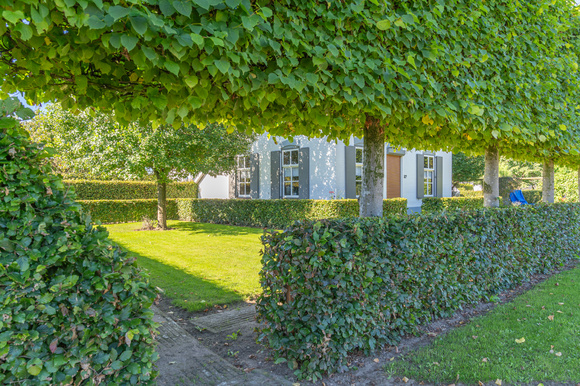
Topiary trees require regular pruning. By continually pruning the new growth, the tree becomes thicker but does not increase in its overall size. This is useful for smaller urban gardens, but also a good solution when the tree is required to fulfil certain functions. Topiary trees can be planted in a row of columns to create a green ceiling, to act as a windbreak or to serve as a sunshade. Creating a green wall - by planting ‘a hedge on stilts’ - is also an attractive solution for reducing overlooking and creating privacy.
Read more about topiary trees in this blog article.
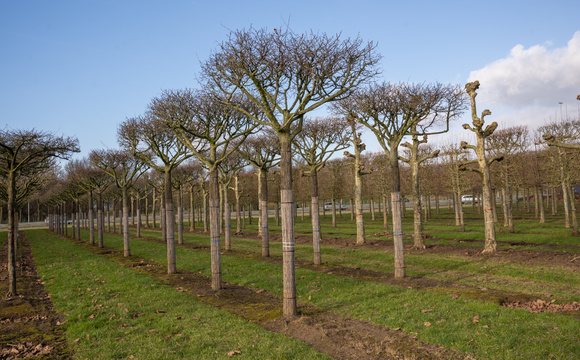
In roof-shaped forms, the tree’s crown is trained into a horizontal plane. This creates a natural parasol. Roof-shaped forms are used in places where a high tree crown is not desirable.
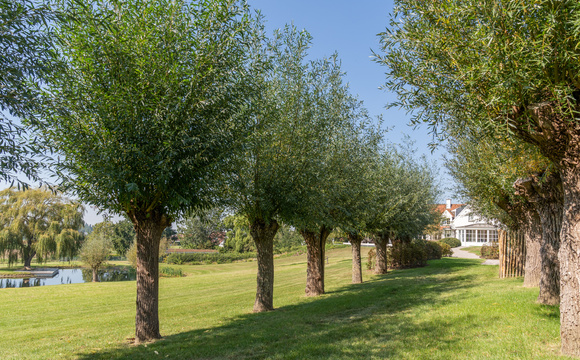
Pollarding trees essentially means removing the entire crown of a tree. Young branches then develop around the edges of the pruning wounds. Pollarding trees is an old practice; the thicker wood and twigs were used, for example, to make broom handles, weave baskets, make clogs and build houses. Pollard trees are beautiful landscape trees with great ecological value.
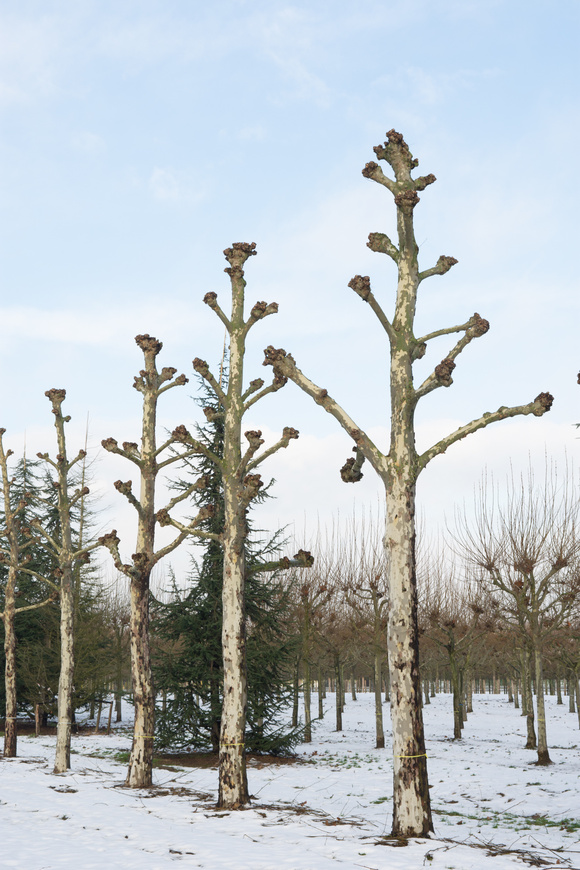
Candelabra pruning means that all lateral branches of a tree are sawn back to around one to two metres from the trunk, usually in a pyramidal crown structure. The tree then resprouts from the pruned branches and forms a compact, dense crown. Candelabra pruning is a drastic form of pruning and may be applied for the following reasons: To transplant a large tree. Since a large tree loses a substantial part of its roots during transplantation, a large part of the crown must also be removed in order to give the tree a good chance of establishing.
To retain a tree in its location: If a tree has developed too large a crown for the place where it stands - in other words, if the tree is not in the right place - candelabra pruning can be a way to retain the tree and solve the problems caused by the oversized crown.
To retain a tree after storm damage: Older trees that have suffered severe storm damage in the crown or damage to the roots can be saved by candelabra pruning.
To achieve a particular character: When a tree is trained at the nursery into a candelabra form, it develops into a gnarled, characterful tree. This appearance is completely different from that of a mature tree that has always had a full crown and is then candelabra pruned.
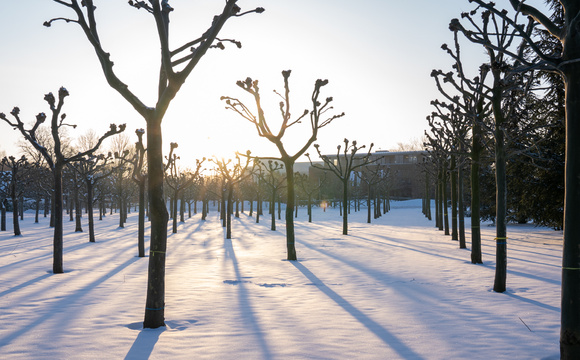
In addition to the candelabra trees trained at the nursery, Boomkwekerij Ebben also offers candelabra forms. These shaped trees have heavy scaffold branches that come together at one point on the trunk. The branches end in beautiful knuckles, which are pollarded every year, making the structure increasingly attractive.
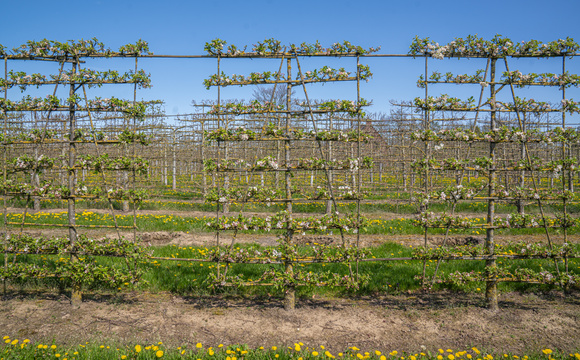
Espalier trees are trees whose main branches are shaped horizontally in a flat plane. These shaped trees are often used in places where space is limited or are planted with the architectural aim of reinforcing certain lines. Espalier trees have been used for centuries. In the landscape, countless old, gnarled specimens can still be found near farms. These are usually lime trees, which were planted to provide shade in summer and shelter from the wind in winter. Espalier trees can be divided into standard espalier trees, and low espalier trees without a trunk or with only a minimal trunk.
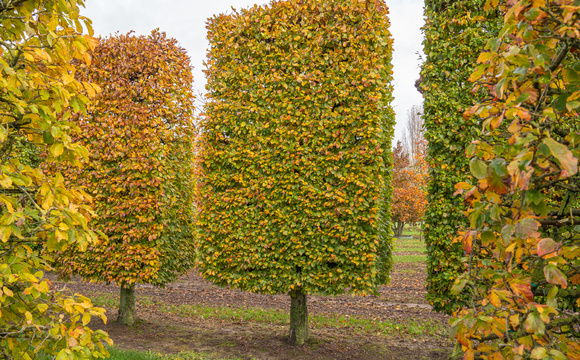
In a screen-trained form (pleached), the crown of the tree is pruned into a dense vertical screen, creating what is essentially a hedge on a trunk. Screen forms are sometimes confused with espalier forms, because they are often created from mature espalier trees. In this case, the espalier tree is no longer pruned back annually to the main branches, but instead trimmed like a hedge. Over time, this develops into a screen form, which is also referred to as a block espalier form.
However, trees are also cultivated directly into screen forms without first being trained as espaliers. Screen forms can further be divided into standard screen forms and ground-level screen forms. Both types are used to create privacy, provide screening, divide spaces, or offer shelter.
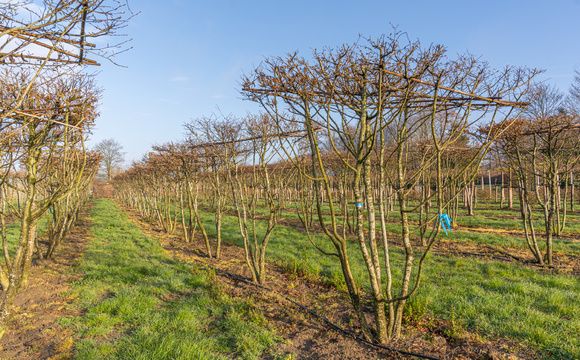
A multi-stemmed parasol is created from a multi-stemmed tree whose crown is pruned into a horizontal plane on the underside. This creates a beautiful, natural parasol, particularly suitable for roof gardens and parks.
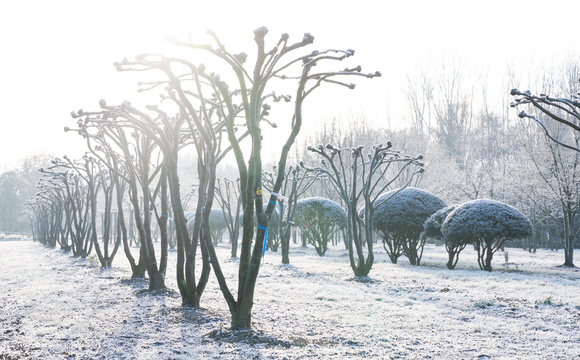
In a multi-stemmed roof tree, the entire crown is pruned into a horizontal plane. These roof trees are particularly suitable as shade trees in places where there is little room for a high crown, while the structure of the stems adds extra character at eye level.
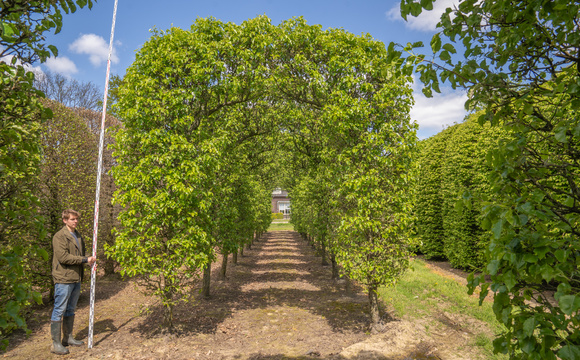
A berceau is also known as a leafy walk and is a gateway or tunnel made of feathered trees whose tops are joined together. The berceau is enclosed at both the sides and the top. Sometimes openings - windows to the surroundings - are created in the berceau. In earlier times, berceaux gave ladies of standing the opportunity to walk through the garden without being exposed to the sun.
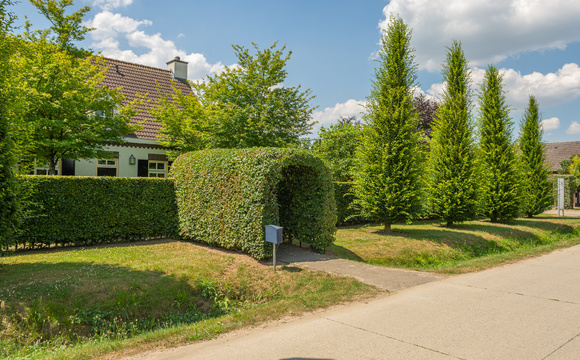
Hedges consist of feathered plants from which a hedge structure can be created. After planting, the plants are pruned for the first time, with the tops and sides trimmed evenly so that the plants grow on uniformly into a beautiful, dense hedge. Hedge elements are fully pre-shaped at the nursery. After planting, they immediately form a dense hedge and require only minimal pruning to keep them even in height and width.
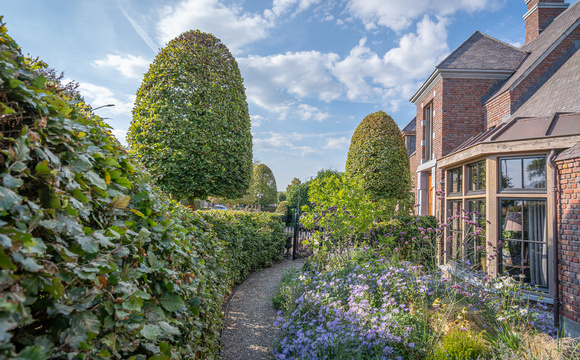
These shaped trees are created by clipping the crown into a particular geometric shape from an early stage, such as a globe, cube, cylinder, beehive or trapezium. Thanks to their appearance, these shaped trees can be used effectively in both classical and modern designs. In addition, clipped shaped trees are easy to keep under control above ground, and because of their limited above-ground volume, they also require less space below ground. Examples of geometric shapes include: beehive, globe, block, cylinder, egg, cone, pyramid, bowl, trapezium and column.