Pruning shaped trees

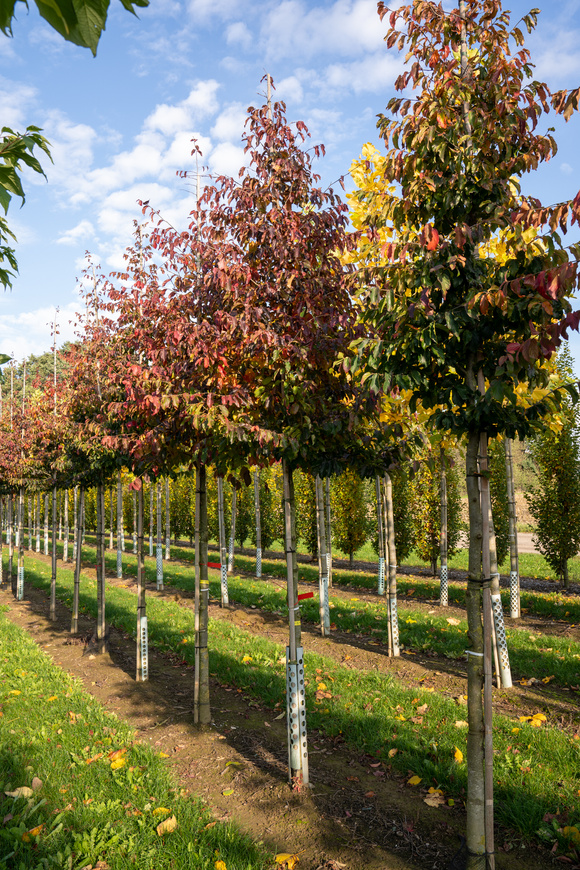
Standard trees are often planted along roads and avenues and are then guided towards a clear stem height of 2.50 to 4.60 metres, depending on the required or desired clearance height for traffic. This means that branches at the bottom of the crown are removed annually until the correct height has been reached. At our nursery, standard trees are already prepared for their final planting site, meaning that part of the trunk is cleared of branches. How large that clear section is depends on the overall height of the tree.
The clear stem height of a tree cannot be increased indefinitely; a certain proportion between the clear stem and the mature crown must remain in order to keep the tree in balance. That proportion between clear stem and crown height is at least 1:2. When the clear stem of a tree along a road needs to be 4.6 metres, this proportion can be achieved by choosing a species with a mature height of at least 14 metres, which means a tree of the first or second magnitude.
A feathered tree has a straight central leader or trunk, which is branched from bottom to top (feathered). A tree growing in the open field will naturally always develop as a feathered tree. In a feathered tree, only the problem branches need to be pruned (see maintenance pruning).
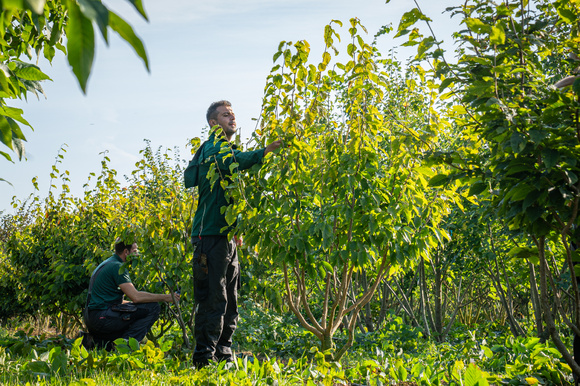
Every multi-stemmed tree has - even at a young age - its own identity and characteristics, which can be strengthened through proper management. Some managers find the maintenance of these tree forms difficult, precisely because they all differ in shape. The management of a multi-stemmed tree comes down to:
- Removing rubbing and broken branches.
- Removing dead wood.
Where necessary, removing young branches from the stems in order to raise the crown of the multi-stemmed tree. The reasons for this may include: highlighting the crown with a ground spotlight, using the space beneath the crown for underplanting, allowing the multi-stemmed tree to serve as a natural parasol above a bench, increasing the sense of safety by making the multi-stemmed tree transparent up to eye level, emphasising the crown shape of the tree, making the structure and diversity of the stems more visible for the experience of nature, or creating greater appeal as a climbing tree for children.
Weeping trees require little management; maintenance pruning mainly consists of removing dead wood. The rubbing branches that are abundantly present in weeping trees do not need to be removed. A weeping form is shown to best advantage when the branches grow all the way down to the ground. Often, however, the lower part of the branches is clipped in order to make use of the space beneath the tree. At a later age, weeping willows in particular must be reduced to limit the risk of the heavy scaffold branches on the outside breaking out. When this pruning is carried out in time, the habit of the weeping tree can be preserved and it is not necessary to create branch stubs by means of candelabra pruning.
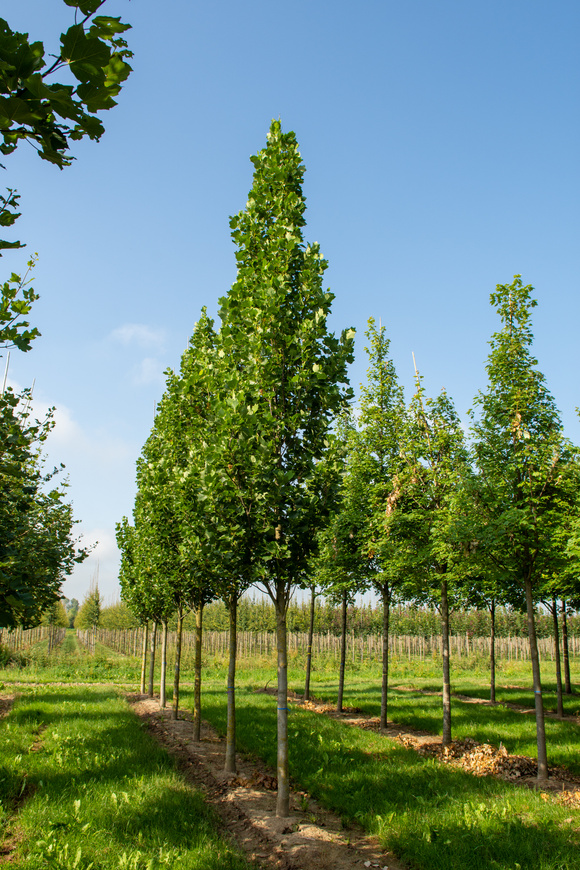
Because of the growth habit of columnar trees, problem branches such as double leaders, suckers and included bark unions often develop and must be removed in good time. In a number of species, the columnar shape has to be maintained by clipping the tree. These species grow slim and upright in their youth, but spread more and more with age, causing the shape to become untidy. Some columnar trees are also prone to branches breaking out during early snowfall - when the leaves have not yet fully fallen. One example is the columnar oak (Quercus robur ‘Fastigiata Koster’). The almost vertical branch angle of this species means that the branch attachment is comparable to an included bark union and that the branch quickly becomes top-heavy, causing it to break out. Temporarily reducing lateral branches is therefore important in these species.
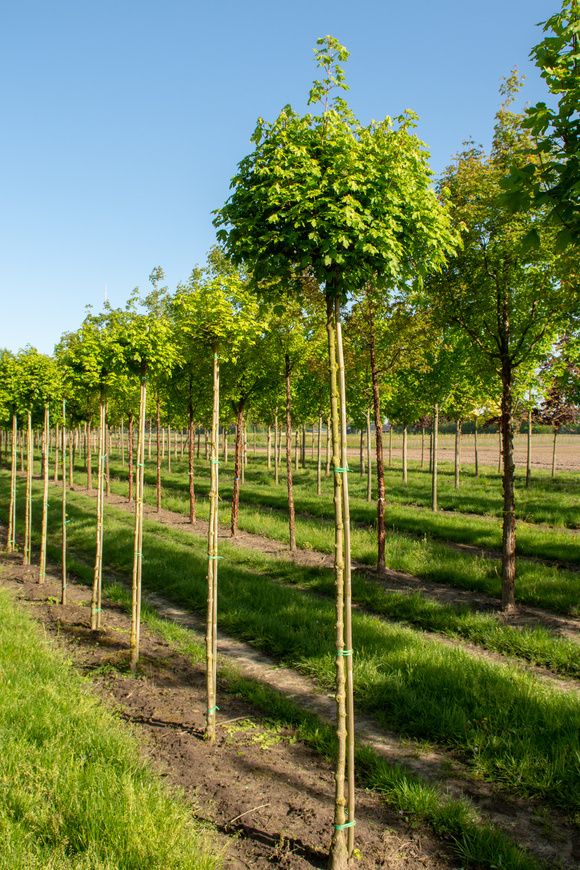
Pruning globe trees differs from species to species. For example, the globe false acacia (Robinia pseudoacacia ‘Umbraculifera’) can be pruned back annually like a pollard tree, whereas the globe ginkgo (Ginkgo biloba ‘Mariken’) requires no maintenance because this species grows very slowly. In general, the tree can be pruned back when the crown becomes too large or loses too much of its globe shape. This can be seen clearly in the standard globe catalpa, Catalpa bignonioides ‘Nana’. Without regular pruning back, a large part of the globe will break out. The pruning of globe trees corresponds fairly closely to that of pollard forms.
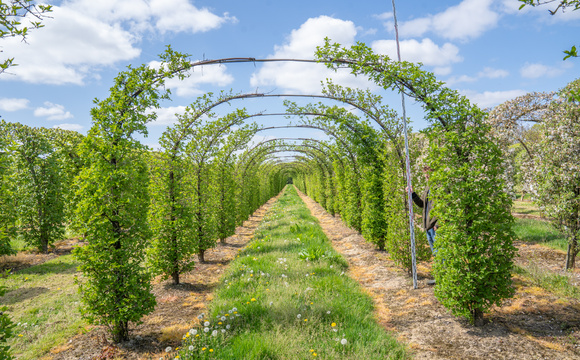
Berceaux, also known as leafy walks, should be clipped at least once a year to maintain their shape, provided the planting consists of hedge plants. To maintain a good appearance throughout the year, pruning twice a year is also desirable here. Annual pruning is best carried out in the late summer months, while twice-yearly pruning is best done in June and September. Hardly any branches will grow on the inside of the berceaux, because little light reaches there. Sometimes it may be necessary to remove stem shoots or root suckers on the inside. A berceau makes most of its growth on the outside, in the tops of the trees. If fruit trees have been chosen for use as a berceau, then the pruning method used is that of espalier fruit.
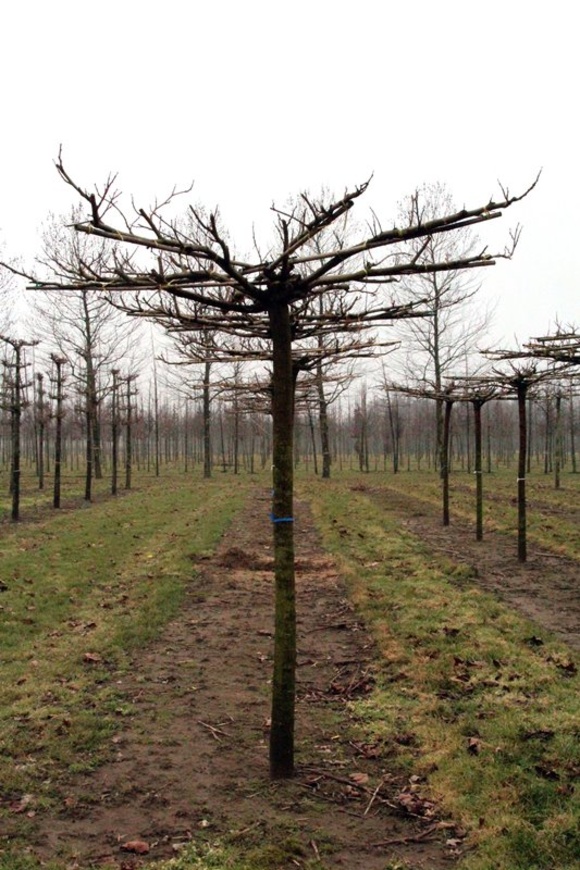
Roof shaped trees produce vertical shoots on the horizontal main branches. These must be removed annually in order to maintain the roof shape. If this is not done, the roof shape will eventually develop into a large crown. There are also so-called clipped roof trees, in which the vertical shoots are clipped back to a certain height in order to maintain the roof shape. This works well with trees that have fine wood and small leaves; trees with coarse wood and large leaves are much less suitable for clipping into shape. Pruning takes place from the end of November, once all the leaves have fallen. In the case of planes, it is preferable to prune in early spring, when the buds begin to swell and move. Roof-trained planes produce annual shoots of up to two metres, and pruning in early spring helps to limit this growth. It is better not to prune planes when they are in leaf, because the leaves release a substance that causes allergic reactions in many people.
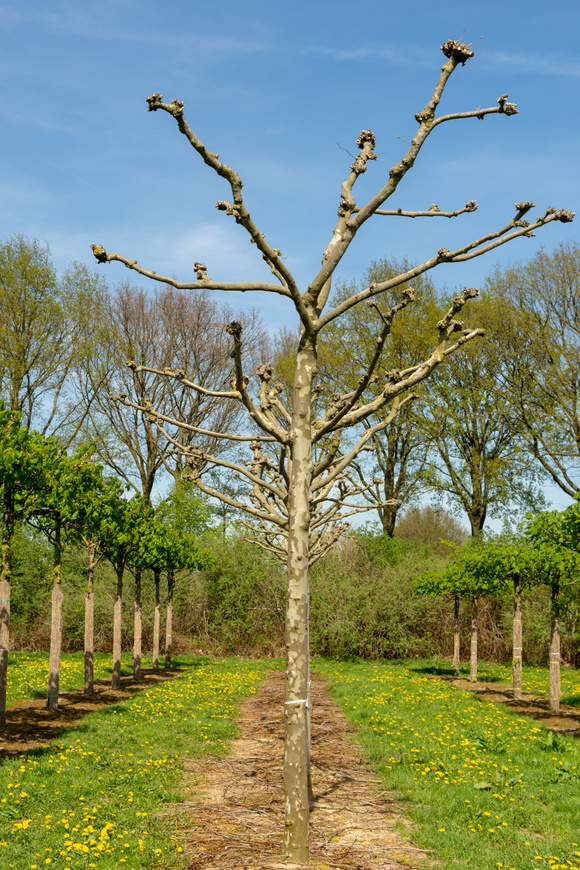
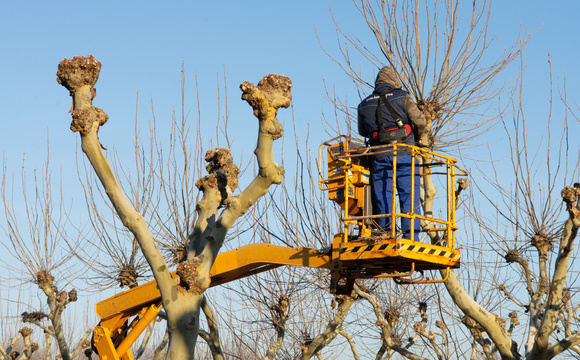
Some tree species, such as planes and lime trees, tolerate candelabra pruning very well, while other species tolerate this intervention poorly. Beeches suffer bark scorch after candelabra pruning, and fruit trees will not bear fruit in the first year afterwards, as they flower on two-year-old wood. In general, candelabra pruning is not desirable for a tree. It creates large pruning wounds that need a great deal of time to grow over. After candelabra pruning, the tree must be pruned every three to five years. During this process, all branches that have developed on the stubs are removed. The attachment of these branches is often very poor and, if they are not removed regularly, there is a high risk that they will break out under their own weight or during storms. The best time to carry out candelabra pruning and to remove the branches from the stubs is in the late autumn months, when all the leaves have fallen from the tree and the sugars have been stored in the wood.
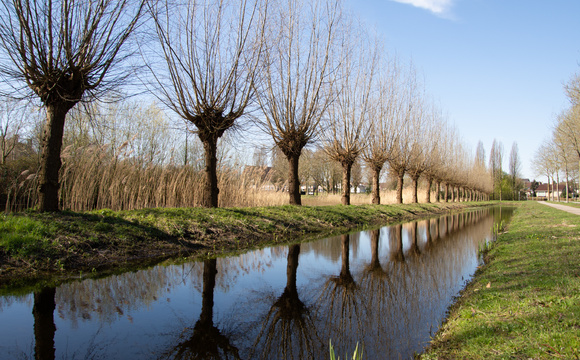
Pollard trees must be pollarded at least once every five years. If this is not done, the branches become too heavy, which may cause them to break out and the tree to split. Pollard trees should be pruned from the end of November onwards, when all the leaves have fallen and the leaf sugars have been stored in the old wood. This gives the tree the energy to flush well again in spring.
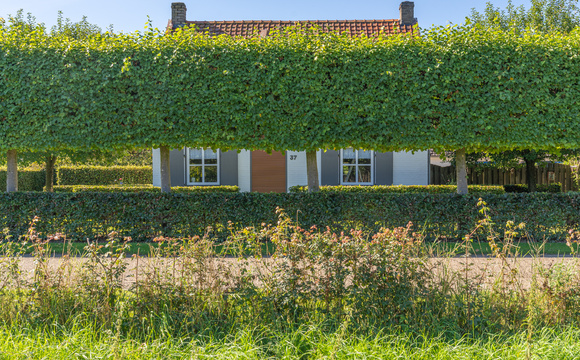
Espalier trees must be pruned back annually to the main branches in order to maintain their appearance. The best time for this is at the end of autumn or the beginning of winter, when the tree no longer has leaves and the structure can be seen clearly. In addition, the espalier tree presents a more attractive appearance in winter when it has been pruned. Pruning in spring is discouraged. Because the sap flow has then started, some species may begin to bleed, with all the associated problems.
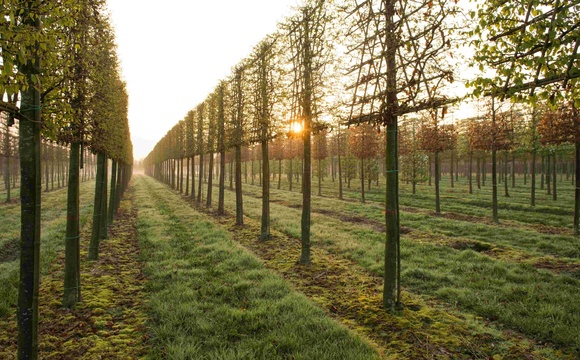
Espalier screen trees are clipped once or twice a year to maintain their shape. The frequency depends on the species: a holm oak (Quercus ilex) will only need to be pruned once a year, while a field maple (Acer campestre ‘Elsrijk’) should be pruned twice a year to keep its shape neatly. If it is pruned once, this is best done in the late summer months. By then, the strongest growth has passed and the tree will retain its shape for a longer period. If it is pruned twice, the first pruning is carried out around the longest day.
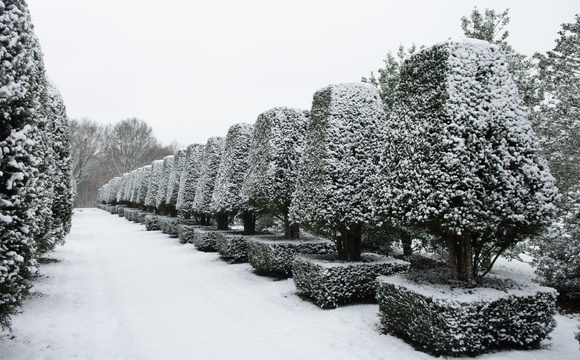
Beehive, globe, block, cylinder, egg, cone, pyramid, bowl, trapezium, column
Shaped trees whose crowns are clipped into a particular geometric shape must be clipped at least once a year to maintain their shape. To ensure they look their best throughout the year, pruning twice a year is desirable. A single annual pruning is best carried out in the late summer months, while pruning twice a year is best done in June and September.