Living environment
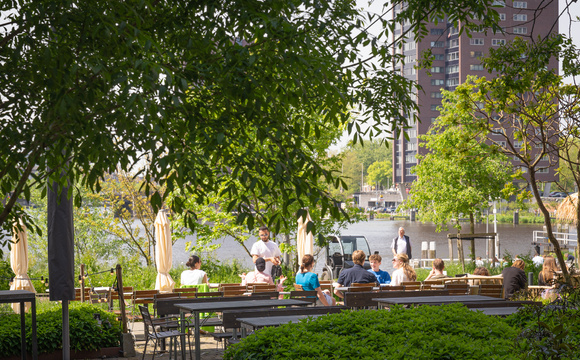

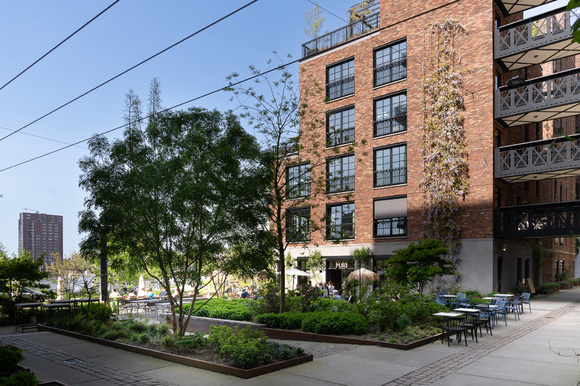
Large trees have an enormous impact, both ecologically and economically. In urban areas, planting large trees means investing in a healthier living environment from the outset. And by large trees, we mean specimens of considerable trunk girth and crown volume. The greater the leaf volume, the more functions the tree can fulfil at the same time. The larger a tree, the greater its effect on its surroundings. Increasingly, research shows that it is not trunk girth but crown volume that determines a tree’s contribution to the climate and to a healthy living environment. Large trees fulfil several functions simultaneously. They store more CO2, provide more shade, improve air quality more, support more biodiversity and offer greater water retention during drought. One tree can therefore be more valuable than twenty small saplings. At the same time, we must not lose sight of species diversity in order to prevent monoculture.
It can therefore be worthwhile not to wait decades for smaller trees to reach maturity, if we can already create at planting the benefits that large trees provide.
A large tree provides more services to its surroundings than a small tree. But how much tree crown volume is needed as a minimum to achieve an effect? The new National Tree Standard issued by the Dutch Tree Standards Institute provides the following guideline: 2.2 m³ of tree crown volume (TCV) per m² of land area. This standard provides a clear and measurable target for creating a greener and healthier living environment. It looks at the contribution of trees to biodiversity and climate goals. A large tree has a more substantial crown volume, root volume and leaf surface area. At Boomkwekerij Ebben, we define large trees as trees with a trunk circumference of 60 to 140 cm. These trees are approximately eight metres high and above. The volume of trees is related to the number of services they provide to their surroundings. Trees with a larger trunk diameter have a greater woody biomass, allowing them to store more carbon dioxide than smaller trees. In the same way, the ability of trees to intercept rainfall and air pollutants increases as the crown and total leaf area become larger. The percentage of tree crown volume in cities is important for various reasons, particularly in relation to biodiversity, climate adaptation and tree health, as well as from an ecological, economic and social perspective.
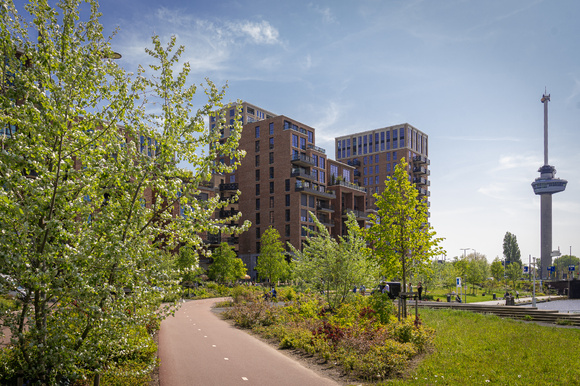
Climate trees are future-proof trees that can withstand extreme weather conditions and recover quickly from climatic challenges. In a changing climate, future-proof trees are becoming increasingly important, particularly in urban environments where the extremes are greater. Heat, drought, heavy rainfall, air pollution and limited space for crown and root volume place high demands on urban trees. Future-proof species are resilient and adapted to these conditions. Climate trees can tolerate extreme weather conditions, have a deep and strong root system, and are resistant to urban stress factors such as air pollution, compacted soil and limited rootable space. In addition, they are adaptive, meaning they can adjust well to changing conditions such as salinisation or soil compaction.
Choosing tree species for the city requires a considered approach, in which origin, growing site, expected lifespan and ecological value are central. Climate-resilient species such as Gleditsia triacanthos, Celtis occidentalis and Ulmus minor are real powerhouses for urban use and are rightly being planted more and more often. Diversity is also essential: variation in species, size and age structure helps to prevent large-scale losses due to diseases or pests. Aside from choosing the right species, design and implementation also play a decisive role in the future-proofing of a tree. A good, spacious growing site with sufficient light, air, water, nutrients and underground growing space is essential for healthy and vigorous growth. Well-growing trees contribute to biodiversity, cooling and the liveability of a city. Download the climate trees poster or make a selection of climate trees in TreeEbb.