Trees and ecosystem services
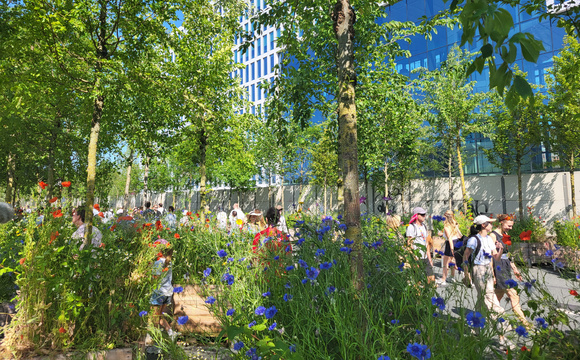 Amsterdam, 750 years. Trees provide cooling during the festival on the ring road.
 Amsterdam, 750 years. Trees provide cooling during the festival on the ring road.
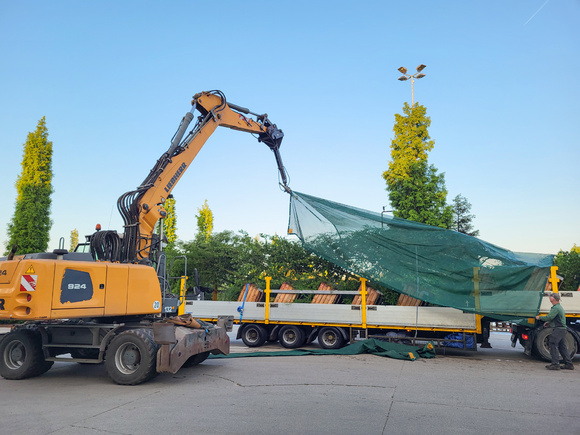 Amsterdam, 750 years. Preparing tree transport at the nursery.
Trees are natural air purifiers that help to reduce the harmful effects of pollution. In relation to health, this mainly concerns reducing the effects of particulate matter, soot, nitrogen dioxide and ozone. Trees have a direct influence on the concentrations of these substances and on the movement of air. They purify the air in several ways. They absorb pollutants: plants have pores in their leaves that can take pollutants out of the air. In this way, they absorb harmful gases. They also filter polluted airborne particles, as plants are able to trap suspended particles in the air. In addition, trees release oxygen into the air, which is essential for human health and for life on Earth. Oxygen is not only needed for breathing, it also helps to purify the air by oxidising pollutants and thereby reducing their harmful effects. Trees are also capable of breaking down pollutants through a process known as phytoremediation. This means that they can convert harmful chemicals into less harmful substances.
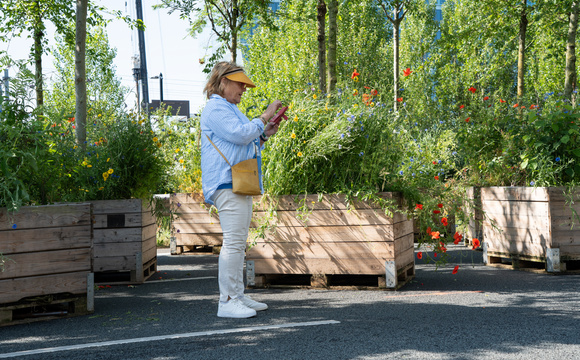 Amsterdam, 750 years. Trees provide cooling during the festival on the ring road.
Trees are natural temperature regulators in the city. They provide shade and actively cool their surroundings through evaporation. This process, evapotranspiration, means that water evaporates through the leaves and in doing so removes heat from the air. On a warm summer’s day, a mature tree can evaporate hundreds of litres of water per day, which can lower the temperature in the immediate surroundings by several degrees. Trees also provide shade on paved surfaces such as streets and squares, so that these heat up less and radiate back less heat. This limits the so-called urban heat island effect that often occurs in urban areas. Tree species with a dense and broad crown are the most effective in this respect. Trees are therefore an essential part of a well-functioning city. Want to know more about this subject? Read the full article.
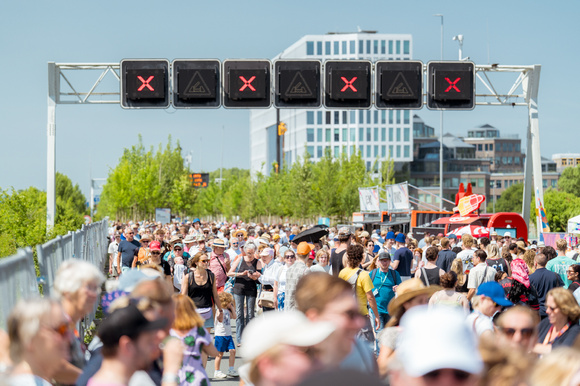 Amsterdam, 750 years. No cars, but trees and crowds during the Festival on the Ring.
One of the most important functions of trees is the storage of carbon (also known as carbon dioxide, abbreviated to CO2). Carbon storage is crucial for mitigating climate change. If the amount of CO2 in the atmosphere continues to rise, the temperature on Earth will continue to increase as well. This has devastating consequences, including the extreme dry and wet periods we experience, with resulting damage to the living environment and agriculture. Trees store carbon by absorbing CO2 from the atmosphere during the process of photosynthesis. They use this to grow their trunks, roots, branches and leaves. The amount of carbon stored in trees varies depending on species, age, size and location. Trees in tropical rainforests, for example, can store considerably more carbon than trees in temperate regions. This is due to their high growth rate and the tropical climate, which allows them to remain active throughout the year. Large, old and veteran trees with a great deal of woody biomass store more carbon than young trees. This immediately highlights the importance of preserving old trees and forests. A tree retains its stored CO2 as long as the felled tree does not burn or decay. Much felled timber is used as a construction material in building, which means the stored carbon is retained. If the wood is burned after use or allowed to rot away, the CO2 is eventually released after all. In the case of burning, a huge amount of CO2 is released at once, along with many other harmful gases and soot particles. Trees are not the only things that store carbon; soil and water store it as well. Want to know more about this subject? Read the full article.