Insects: bark and wood borers

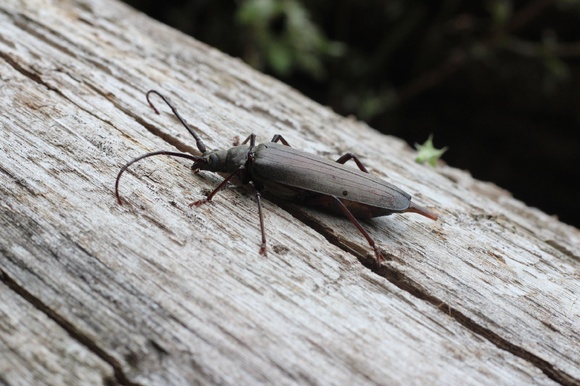
Longhorn beetles (Cerambycidae) are beetles notable for their long antennae, often longer than their bodies. They occur worldwide and play a role in the breakdown of dead wood. Some species, such as the house longhorn beetle, can cause serious damage to timber structures as well as to living trees. The white larvae bore deep into the wood, and their network of tunnels leads to weakening of the plant material. Especially in recent planting, it is important to detect longhorn beetle activity in time. In order to determine appropriate control measures, knowledge of the behaviour and life cycle of longhorn beetles is crucial for the preservation of healthy trees. It is also important to follow the planting instructions carefully in order to ensure proper planting. An infestation can be observed on the trunk, thick branches and also at the root collar. Here, round to oval bore holes with a diameter of between 5 and 10 mm may be visible. Bore dust and sawdust worked out of the galleries by the larvae can also be found. In the crown of the tree, discolouration, fallen leaves or dead branches may be seen. To protect the tree against longhorn beetles, it is advisable to apply ESK to the bark, especially during the first two years. This product acts as a natural deterrent and gives off a distinctive smell that repels the insects. The product is composed of various plant extracts bound with a natural adhesive. It must be applied before the beetle reaches the tree.
The oak processionary caterpillar (Thaumetopoea processionea) is a caterpillar that is common on oak trees in late spring and summer. The caterpillars live in large groups and move in characteristic ‘processions’ on and around the tree. They can be recognised by their light grey colour, orange warts and fairly long hairs. They feed on young oak leaves and cause allergic reactions in people who come near the tree through the release of so-called urticating hairs. These can cause severe irritation in both humans and animals, such as itching, red patches, skin rashes and respiratory problems. The caterpillars build silken nests on trunks and branches, which hang like large balls from the branches. Control measures are especially necessary in busy places such as parks and along cycle paths and footpaths. The nests are removed manually using a powerful vacuum system. Young larvae can also be killed in a natural way by using nematodes, which are sprayed into the tree. Long-term control depends on encouraging natural enemies already present and improving the ecology by installing nest boxes, applying extensive verge management and creating a varied understorey of woody plants.
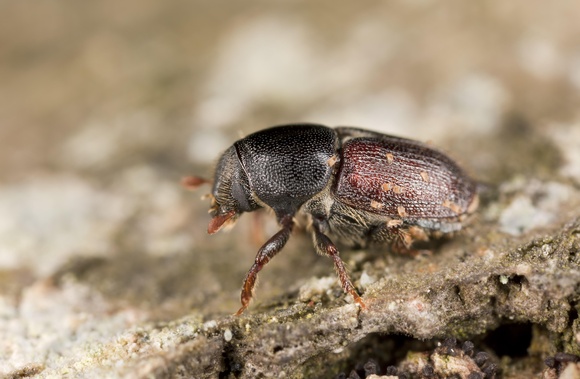
Newly planted oaks are often under stress as a result of transplanting, which makes them a ready target for the oak bark beetle. The oaks release a stress hormone that attracts the beetles. The oak bark beetle (Scolytus intricatus) is a small beetle measuring 3 to 4 mm, with a shiny dark brown to black wing case. It attacks weakened oaks, bores through the bark and then feeds short, horizontal galleries into the living wood, across the grain of the bark. In this maternal gallery, the beetle lays its eggs. The larvae that hatch from these eggs feed long new galleries at right angles to the maternal gallery and pupate at the end of them. Once they emerge, the young beetles finally bore their way out of the tree through the bark, after which the cycle begins again. To ensure that a tree experiences much less stress in its first year, we recommend pruning it ready for planting. This is certainly advisable with oaks. Pruning ready for planting means that about one third of the lateral branches in the crown are cut back. This keeps the root-to-crown ratio in balance, so that the tree loses less water through the leaves and experiences less stress. Because water shortage makes newly planted oaks more susceptible to infestation, sufficient watering should be provided during dry periods.
Download brochure: protecting oaks against the oak bark beetle.The pear jewel beetle (Agrilus sinuatus) is a native beetle with a copper-red wing case and a length of 8 to 10 mm. The beetle is mainly found on trees and shrubs in the Rosaceae family, including Pyrus, Sorbus and Crataegus. The damage is caused by the larvae developing beneath the bark of weakened trees. The first signs of damage are reduced growth and branch dieback. The beetle is attracted only to weakened trees, so the best preventive measure against infestation is to ensure that trees remain healthy, with a good growing site and adequate aftercare during the first years after planting.