Weather Influences

In recent years, we have increasingly been experiencing warmer and drier periods in spring and summer. This, in combination with drought stress and intense sunlight on trunks with thin bark, causes the bark tissue to die. Trees are particularly prone to bark scorch between 3.00 pm and 5.00 pm, when the sun is lower in the west to south-west, at a compass bearing of 235–245 degrees. The temperature of the bark can then rise to as much as 45 degrees. At that point, the sap flow no longer cools the bark sufficiently, causing temperature differences within the bark to create stresses in the wood. Parts of the bark may also dry out completely.
Often, this bark scorch cannot yet be detected in the first year. However, once the tree starts to increase in girth (around mid-September), or when the sap flow begins again in the following year, a gradual greying or discolouration can be observed on the south-west side of the trunk. After a few weeks, the bark will split open from the base of the trunk up to a height of 1.5 to 2 metres. In some cases, bark scorch also occurs higher up in the crown, but always in places where the foliage does not provide shade or a cooling effect through evaporation on the trunk. Where the bark splits open, weak points develop that make the tree more susceptible to invasive fungi. Newly transplanted trees in particular, or trees that are suddenly exposed to sunlight, may suffer from this, because the limited number of roots means that the tree cannot take up enough water.
Trees with thin bark are at greatest risk of damage from bark scorch. Traditionally, this includes Acer, Alnus, Carpinus, Fagus and Tilia, but we are also increasingly seeing damage in Aesculus, Fraxinus, Juglans, Magnolia, Liriodendron and Paulownia, among others. After planting, these trees must be properly protected. How?
Prevent drought stress by purchasing regularly transplanted trees.
Ensure a well-prepared growing site without compacted layers, where the existing stable humus content is at least 1% and is maintained, but preferably improved.
Water planted and transplanted trees at the correct frequency during the first three years. This can be done, for example, by means of a separate automatic irrigation system, in which trees and solitary plants are watered individually via drip irrigation.
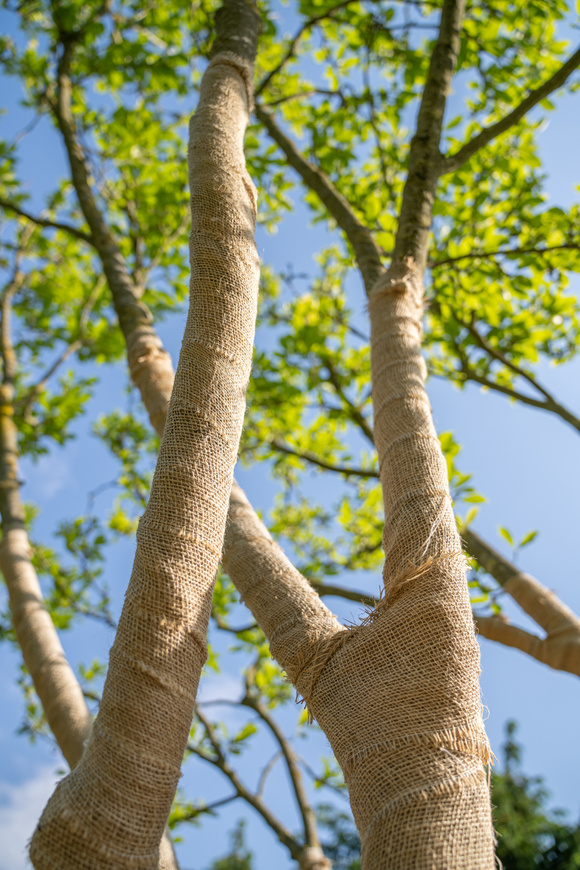
Protect the trunks on the south-west side by applying trunk reflectance. This can be done by means of:
- Reed mats, coconut mats or bamboo mats. These are robust but natural materials that are widely used at the nursery to protect bark against sun scorch. One advantage of these materials is that they can be installed very quickly. In public spaces, they are less suitable because of the greater risk of vandalism. In addition, a tree protected by a reed mat builds up less resistance to the sun, so the crown must be well developed before the reed mat can be removed. The mesh of the mats should therefore be at least 0.2–0.5 cm.
- Trunk coating. This is an old method that was already widely used in Central Europe and also in Western Europe, for example to protect fruit trees against frost cracks. Possible natural products include white lime on a lutum basis, ARBO-FLEX© or kaolin clay (Surround). These protect the trunk and, because the coating gradually wears away, the trunk still builds up protection against solar radiation. The disadvantage is its aesthetic value: not everyone appreciates whitewashed tree trunks in public spaces.
Want to read more about protecting trees against sun scorch? Read the blog.
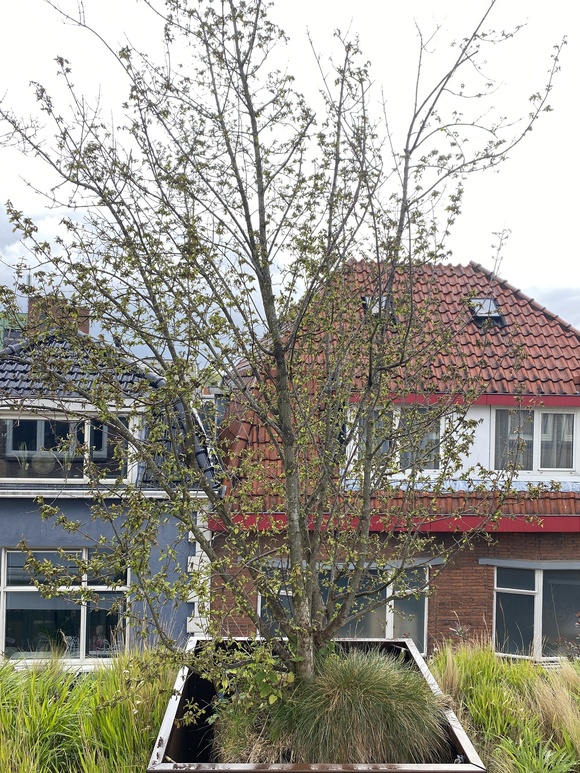
Frost damage occurs when the temperature suddenly drops and the water in the plant cells freezes. This causes cell damage, leading to tissue death. Young trees, newly planted specimens and species that continue growing late into the year are particularly vulnerable. Trees that have been fertilised too late in the season with nitrogen are also at greater risk, because their shoots have not yet fully hardened off. The degree to which a plant is susceptible to frost damage depends greatly on the species. In some species, only the flowers are affected, such as apple (Malus) and magnolia (Magnolia); in others, it is the young emerging leaves, such as dogwood (Cornus) and walnut (Juglans). In both cases, the trees will recover fully, because this type of damage caused by light night frost does not occur every year. The damage often becomes visible once the temperature rises. Typical symptoms are blackened or collapsed, slimy young shoots. In severe cases, cracked bark or peeling bark may also be visible. In deciduous species, the bark on the south side may split open because of major temperature differences between day and night. In spring, frost-damaged trees often leaf out unevenly or remain partly bare. In evergreen species, frost damage is mainly visible in the foliage. Through a combination of frost, sun and wind, the plants often dry out, resulting in brown leaves.
Control and prevention: choose frost-hardy species suited to the local climate and site conditions. Avoid late nitrogen fertilisation and encourage timely hardening of shoots with potassium-rich nutrition. When planting in autumn, a mulch layer helps to protect the root zone against frost. Frost can penetrate deeply into the soil, especially on dry sandy soils. Young trunks can be protected during severe frost with jute, which helps to buffer temperature fluctuations and prevent bark damage. Plants from Mediterranean regions, such as Judas tree (Cercis), are particularly frost-sensitive. Plants with very delicate foliage that emerge early in spring, such as katsura tree (Cercidiphyllum), are also susceptible. Night frost damage is relatively harmless for trees, because it does not occur with the same intensity every year.
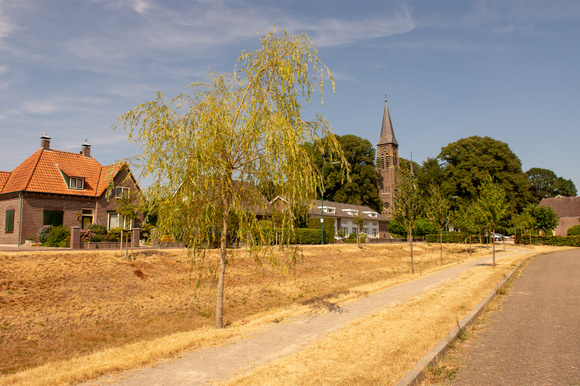
Drought is causing increasing damage to trees, especially in urban areas with compacted soils, limited root space and a great deal of heat from buildings and paving. When water is lacking, the tree’s water balance is disrupted, causing important processes such as photosynthesis and growth to decline. Young trees and species with a shallow root system are particularly vulnerable. The symptoms of drought stress often develop in three stages: drooping leaves, yellowing leaves caused by water and nutrient deficiency, and eventually early leaf fall. At a later stage, branches may begin to die back. Photosynthesis comes to a halt because of the decreasing leaf area. Due to the reduced transport of water and nutrients, resistance declines, making it easier for fungi, insects and other secondary infections to take hold. Prolonged drought can also cause lasting root damage, especially in soils with little organic matter.
Drought prevention begins with the soil. An open soil with sufficient organic matter and root space retains more moisture and supports soil life. A layer of mulch also reduces evaporation. Young trees need extra care during the first years: it is better to give a large amount of water occasionally than small amounts frequently. Insufficient aftercare is one of the main causes of planting failure.
Read all about the correct way of watering.