Preparing the planting hole
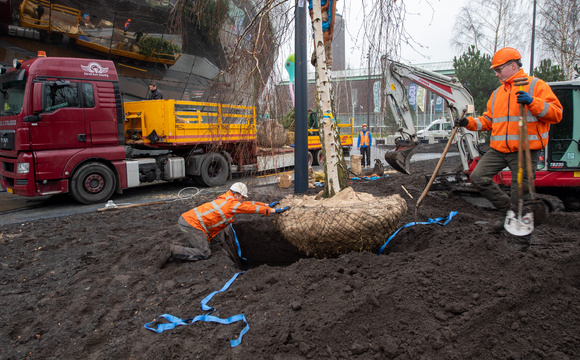

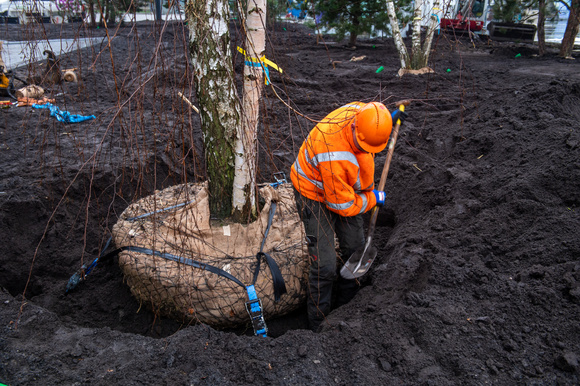
When planting trees, there are a number of preparatory actions that need to be taken into account. The exact planting location must not only be clear, but also the planting order if multiple trees are involved. If the location is very waterlogged, trackway panels should certainly be used to prevent the ground from compacting. Whatever action you take, keep in mind that you are working with a living product and that every action can affect the successful establishment of the tree. Learn more about our planting advice.
- Dig a planting hole one time as wide as the root ball and as deep as the height of the root ball.
- Loosen the bottom of the planting hole and break through any impermeable layers if necessary.
- If using a (mini) excavator, use a toothed bucket to prevent smearing of the planting hole.
- Place the tree in the planting hole and ensure that the root ball is level with the surrounding ground (when deeply loosening the soil, slightly higher because of later settling).
- Leave the wire basket and jute intact. If the wire is against the trunk of the tree, it must be cut through.
- Fill the planting hole around the root ball, firm the soil well and mix any soil improvement into the top twenty cm.
- Create a watering rim or build up a small bank to prevent water from running away during watering.
- Anchor the tree with tree stakes or underground anchoring.
- Finish the rest of the planting bed.
- Check the tension on the anchoring a few weeks after planting because of the settling of the tree.
The correct dimensions for a planting hole are at least one time as wide as the root ball and equally as deep as the height of the root ball. A planting hole must be dug carefully. This is usually done mechanically, in which case it is important that the sides of the planting hole are not cut smooth. Especially in wet soil and in clay- or loam-rich soils, the sides can quickly become smeared, preventing new roots from penetrating them. In that case, the sides of the planting hole must be loosened.
If the planting hole is made with an excavator, a toothed bucket is preferred to prevent smearing. The bottom of the planting hole must be properly loosened to allow deeper rooting and to promote the capillary rise of groundwater. The loosened layer should then be firmed again to prevent excessive settling of the soil - and therefore of the tree. Do note that digging must never go below the highest groundwater level; always remain at least fifteen centimetres above it.
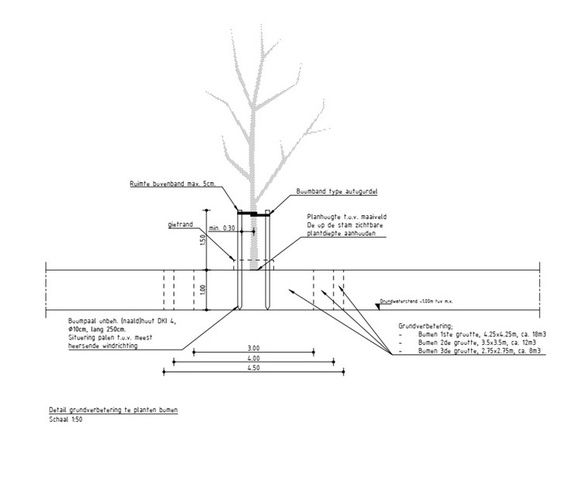
For proper and efficient planting, it is advisable to have all planting materials together and laid out at the work site for each tree. Stakes, tree ties, a watering rim and, where applicable, trunk protection. This allows you to begin finishing the planting immediately after the tree has been placed in the planting hole. It is practical to start with the anchoring so that the tree is fixed in its final position. When using tree stakes, they can also be positioned in advance with an auger, or, if an excavator is being used, they can be pressed into the ground provided the soil is not too compact. In addition, tree ties, a hammer and broad-headed nails are required for above-ground anchoring.