Planting site layout
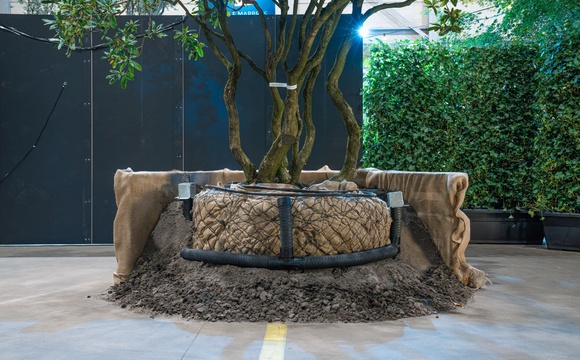

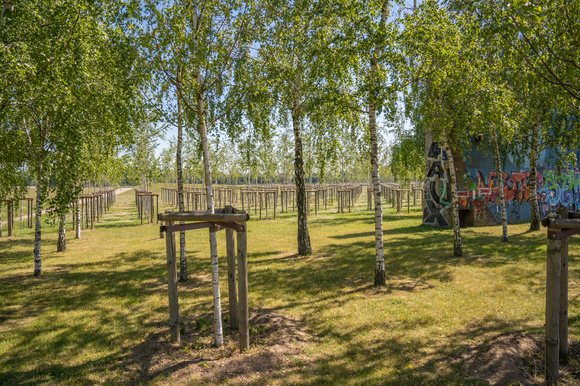
The space a tree is given in the planting hole is not the final space that the root system will occupy. The total rootable volume will, of course, be much greater. This must already be taken into account during the planning stage. As a general rule of thumb, this space can be calculated as follows: rootable volume = 0.75 to 1 m³ per square metre of crown area. A first-magnitude tree increases its crown area by about one square metre per year, and will therefore require an additional cubic metre of topsoil or tree soil each year for root growth. When designing the planting site, it is therefore crucial to base the calculations on the expected lifespan of the tree.
An example – the honey locust (Gleditsia)
For example, a honey locust may live for eighty years in its planting site. This means that the tree must have eighty cubic metres of rootable volume available. An ornamental cherry of the third magnitude may live for only thirty years, will therefore not develop such a large crown area, and so requires a rootable volume of only fifteen cubic metres.
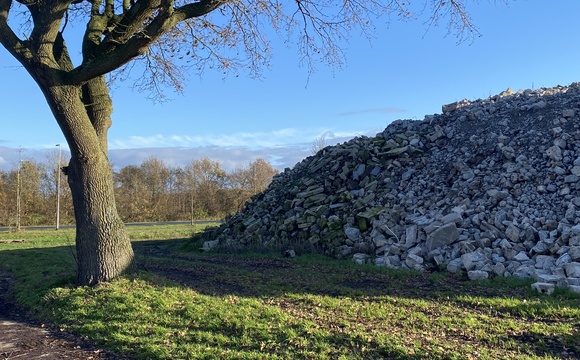
In some cases, the soil around a planting hole is compacted, meaning that it has been compressed by pressure. A mixture of different soil types can increase compaction. A tree’s roots do not penetrate compacted soil, because there is no oxygen present and anaerobic conditions therefore arise. This creates a ‘flowerpot effect’: the roots can find oxygen and nutrients only within the planting hole itself. Even years after planting, this can still lead to disappointing results and even the death of a tree. When it becomes clear during planting that the planting site and its surroundings are heavily compacted, it is necessary to loosen the soil by digging with an excavator.
Urban areas often do not have the best soil for planting trees. Contaminated soil caused by construction works or nutrient-poor soil resulting from raising ground levels with sand is often the reality. Depending on the local soil conditions and the function of the area, there are various ways to improve the soil. All methods of improvement are aimed at adding more humus so that moisture (and nutrients) are retained and the oxygen content in the soil remains at the right level. Structure, load-bearing capacity and the level of organic matter are of decisive importance for successful planting.
This method of planting site design is often used for trees planted in paved areas, because tree sand also provides a good foundation for paving. Tree sand consists of sand mixed with organic material. It is not an ideal growing medium, but a compromise mixture that combines the requirements a tree places on the soil with the civil engineering requirements for paving. Tree sand can be used beneath cycle paths and footpaths. Where greater compaction occurs, for example under parking areas and roads with low traffic speeds, tree granulate is more suitable. This material consists of volcanic lava, provides sufficient nutrients for the tree and can withstand the weight of vehicles. When using tree sand and tree granulate, the volume must be at least one and a half times the calculated rootable volume in topsoil.
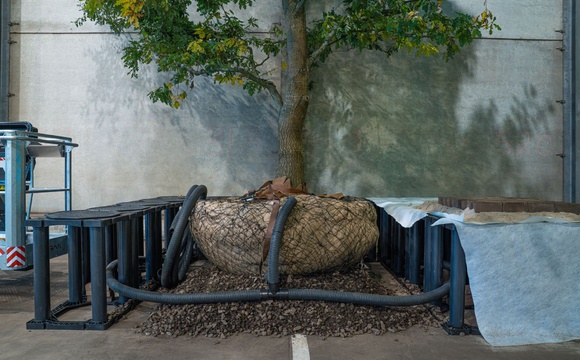
Tree bunkers are fully designed planting systems intended to protect tree roots and provide an optimal growing environment. They can be used beneath paved surfaces, thereby preventing soil compaction and ensuring an ideal water level. Even in heavily used urban environments, trees can grow well in a tree bunker. The system completely relieves the soil of pressure, as the structure and covering take over the load-bearing function. The open space within the structure beneath roads or pavements is filled with a specific substrate. The entire system is designed to provide trees with a long-term growing site
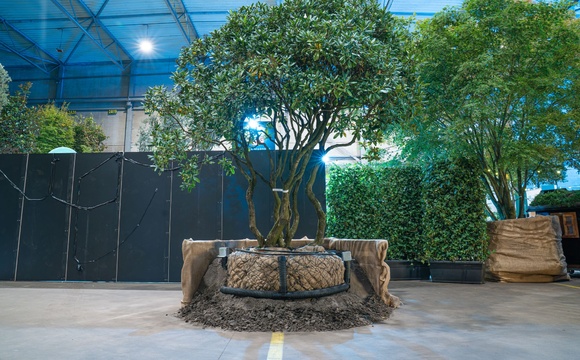
For a tree to grow well, a large volume of rootable space is essential. Not only the quantity, but also the quality of this space plays an important role. Compacted soil is low in oxygen and often forms an obstructive layer that prevents trees from growing. Non-compacted, nutrient-rich soil provides significantly better growing conditions than compacted soil of a comparable volume. This is exactly what the tree bunker provides. It creates a perfect growing environment beneath paving, as if the tree were standing in an open field while the paving effectively “floats” above it. In intensively used urban areas, where the ground is crowded with cables and pipes, the tree bunker makes it possible to provide trees with an ideal growing environment while requiring only minimal underground space.
Between the substrate and the top of the bunker there is an air layer which is connected to the outside air via an aeration system. This promotes healthy soil life, which depends on oxygen. In addition, this air layer can temporarily store rainwater.
Tree bunkers are increasingly being used as a water-retention solution, offering an answer to urban challenges such as extreme rainfall. Rainwater no longer flows directly into the sewer, but infiltrates into the tree bunker. There, it is filtered by the soil and retained, so that in the event of excess water, only purified water slowly percolates into the groundwater. This combination of functions makes the tree bunker ideal for climate-resilient cities and for solutions in sponge city situations.
Tree bunkers provide an uncompacted growing environment beneath paving such as paving slabs, asphalt and the like. This prevents paving from being pushed up, a common problem with load-distributing solutions such as tree granulate and tree sand. Paving displacement can cause high maintenance costs, whereas tree bunkers avoid these costs. Because root heave is prevented and rainwater is managed locally, the maintenance costs of tree bunkers are lower compared with other systems. The system does, however, also have some disadvantages. In areas with a high groundwater level, such as Amsterdam, the use of tree bunkers can be technically challenging and less cost-efficient. Even so, solutions are possible, and they are used in such situations if preventing root heave is a requirement. Tree bunkers are also difficult to use around existing trees. Installing them around existing trees with an extensive root system is virtually impossible. Good preparation and experienced workers are therefore essential, but even so it remains a risky operation.