Overwatering
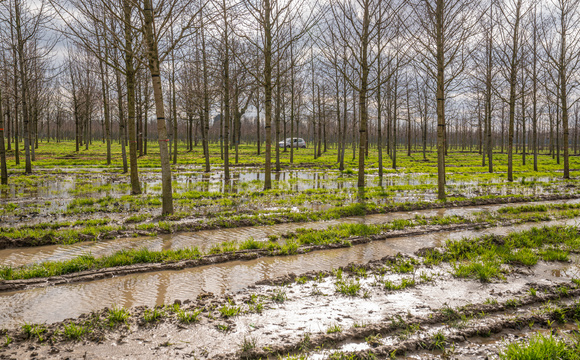

Weather extremes are making tree planting increasingly demanding. After dry years have come extremely wet years, with high groundwater levels causing waterlogging even on sandy soils. Overwatering caused by precipitation not only from rain, but sometimes also from excessive irrigation, leads to root rot, oxygen deficiency and reduced stability. Without oxygen in the soil, root growth is hindered and diseases increase. Good drainage, tailored to the soil type and climate, is crucial for healthy trees. A balance between moisture, oxygen, light, nutrients and soil life is essential. Excessive watering not only affects young planting; established trees can also suffer serious damage. We are happy to help you recognise the symptoms of overwatering more easily.
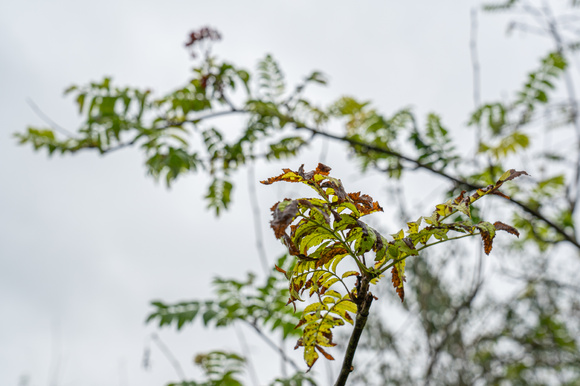
The first symptom of too much water is discolouration of the leaves, which become dull. The follow-up symptoms all closely resemble drought stress, simply because with root rot the tree can no longer take up moisture and therefore effectively dries out. In cases of drought, we see the damage starting in the outermost parts of the crown and moving inwards, whereas in an excessively wet situation this pattern is exactly the reverse. There, the damage spreads from the centre of the crown outwards, while the tips of the branches often remain fresh green.
Deciduous trees on a site that is too wet often show the following symptoms:
Wilted leaves: despite sufficient moisture, the leaves may still begin to droop. The cause is a lack of oxygen at the roots and possibly even root rot, making moisture uptake impossible. This leads to wilting of the leaves.
Leaf discolouration: the tree shows brown leaf margins and yellowing. Overwatering can lead to nutrient deficiency, mainly because essential nutrients are washed away from the roots.
Premature leaf fall and dieback: an important sign of decline is the dieback of young shoots, including the leaves. However, this can also be a sign of too much water. In both overwatering and underwatering, these are signs of a stress response by the tree.
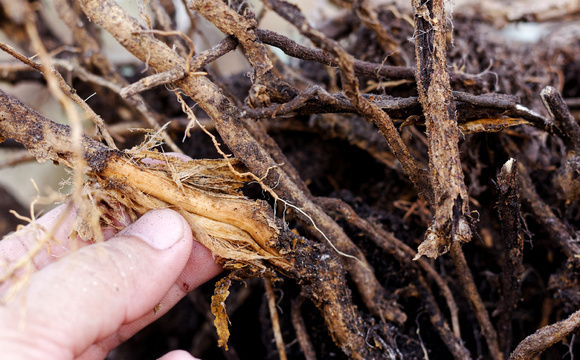
Root rot: nearly all these symptoms are caused by poor condition of the root zone, resulting in root rot. By carefully digging away the soil around the roots, they become exposed; black roots are a sign that they have been affected by root rot. Fungi (such as honey fungus) are also often visible, having a negative effect on the roots and thriving under oxygen-poor conditions. Root rot can also be recognised by a musty smell, sometimes with the characteristic odour of rotten eggs.
Other diseases: diseases such as Phytophthora and Verticillium also frequently occur in cases of excessive watering. The first is a water mould and a precursor to root rot. The second is a wilt disease that blocks the xylem vessels and causes wilting.
Drainage; good water drainage, or drainage, is an important element here. This can be achieved, among other things, by drilling vertical holes with an auger and filling them with lava substrate. Excessive drainage, however, can also cause the tree to dry out. It may also help to apply better planting soil around the roots. This may be tree sand or a mycorrhiza-containing planting soil. Impermeable layers just below the planting hole can also obstruct drainage. This can be identified by means of a soil boring.
Oxygen percentage; oxygen supply around the root zone is essential for proper root development. This plays a particularly important role when planting in paved environments such as streets and squares. Soil compaction around the root package caused by traffic or machinery also lowers the oxygen content. An oxygen percentage of up to 12% causes rotting. Between 12 and 18%, root growth stagnates, and above 18% the root system grows. Trees live in symbiosis with fungi that are necessary for nutrient uptake. These fungi are also highly sensitive to oxygen deficiency. For that reason, nutrient uptake also decreases as soon as the tree experiences a lack of soil ventilation. Planting in soil with sufficient humus-rich material helps restore the balance. Fresh compost, however, must never be mixed into the soil: the decomposition process of compost or woodchips extracts oxygen from the soil. When using well-rotted compost, it is advisable not to mix more than 10% into the planting hole, because of the risk of drawing too much oxygen from the soil.
Moisture content; when planting, it is important that the soil is moist, but no more than that. Planting a tree in a planting hole that has filled with water is strongly discouraged. Working wet soils before planting is also not advisable, because this compacts the soil. Compaction in water-saturated soil can even allow ‘harmful’ fungi – such as Verticillium – to develop. For optimal planting results, it is advisable always to work in dry conditions.
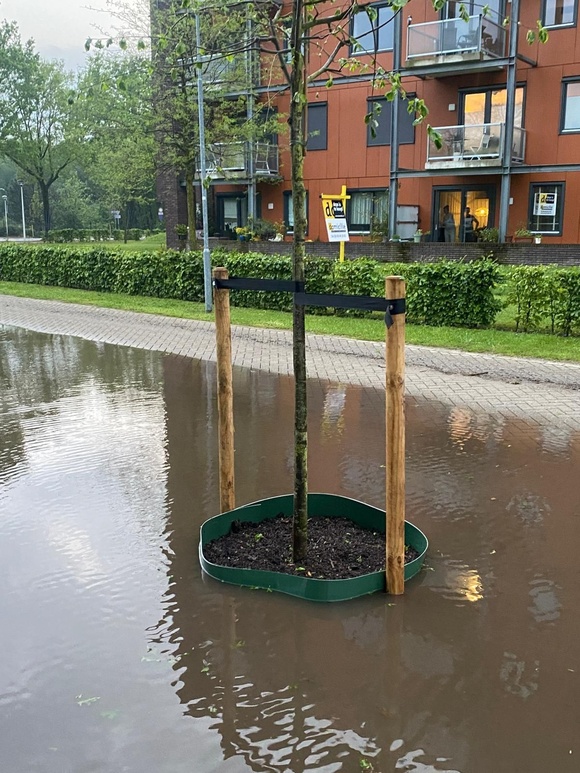
In many places where trees are not surviving this wet year, the cause lies in the planting site conditions. This may be because work was still carried out in wet conditions, which has ruined the soil structure. It may also be because the tree was planted too deeply in relation to the ground level and/or the groundwater level. Because of the completely wet planting site and the lack of oxygen, the tree fails to root out from its root ball and produces too few or no fine roots, which are crucial for the uptake of water and nutrients. A root ball consisting of a different soil composition from the surrounding soil may also dry out because it does not take up water. Wet locations are often very localised, so the moisture content of the root ball should always be assessed separately from that of the surrounding soil.
The simplest way to take wet conditions into account is to plant the trees on a small mound: make sure that the bottom of the root ball is always planted above the highest groundwater level. This ensures that water always drains away from the root ball and that the roots always receive sufficient oxygen when the groundwater level is high.
There are certain tree species, often those with fleshy roots, that struggle more in wet conditions and in structureless soils. These include Fagus sylvatica (common beech), Sorbus (rowan), Prunus (cherry), Acer (maples) and Juglans (walnut). This does not mean that they can no longer be used; however, it is advisable to avoid wet situations. Extra attention to the planting site and soil types makes it possible to continue using these trees.
Some tree species are highly adaptive and can tolerate flooding. In many cases, these are only short-term floods and the trees are already well established. Real strong performers that can cope better with prolonged flooding include Salix(willow), Alnus (alder), Taxodium (swamp cypress), Populus (poplar) and Ulmus (elm). In situations where permanently wet conditions are expected, it is better to choose young trees for planting, as they can cope more easily with wet conditions. Choosing the right tree species for wet situations is easy in TreeEbb.