Finishing the planting area
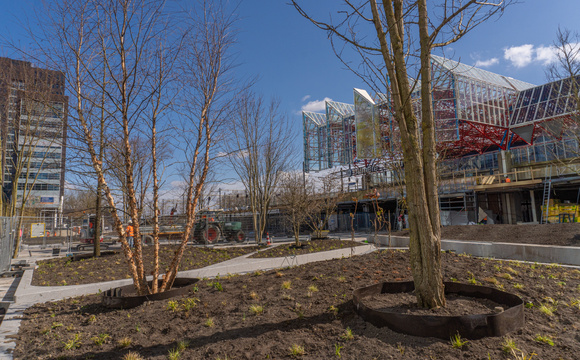

Once the soil around the root ball has been firmly trodden down, the top layer can be finished. Usually, simply raking it level is sufficient, with enriched planting soil added if required depending on the planting chosen for the bed. It is important that no planting is placed directly on the root ball. The root ball itself should therefore remain free of planting. It may, however, be sown right up to the edge of the root ball. Because the top of the root ball remains fully intact, including the jute and wire basket, there is also no room to place other planting directly beneath the tree. Where irrigation is used, it is also important to leave space for this, and if the pipework is already in place, it must be handled carefully to prevent leakage.
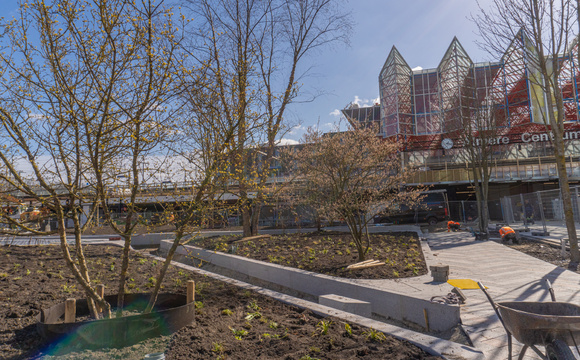
A plastic watering rim around a newly planted tree fulfils several important functions as a watering rim, especially in the first years after planting. The watering rim forms a raised edge around the root ball, preventing irrigation water from flowing straight away to the surrounding planting and ensuring that it remains concentrated within the root zone. This allows the water to infiltrate the soil more effectively and provides the young tree with moisture more efficiently. This is particularly crucial during the establishment phase, when the root system still has to develop and the tree is especially vulnerable to drought stress. Thanks to the improved and more even water supply, the likelihood of successful establishment and healthy growth increases considerably.
In addition, the watering rim helps to limit water loss through surface run-off, for example on light sandy soils where the surface can quickly seal, and it also indirectly reduces rapid evaporation. The rim makes it possible to apply water and, where applicable, fertilisers or soil improvers in a targeted way, so that they end up exactly where the tree needs them and waste is prevented. The watering rim also has a protective function: it clearly marks the tree pit, reducing the risk of mechanical damage to the trunk and root zone caused by mowing, foot traffic or maintenance work. In combination with mulch, the watering rim can also help to keep weed growth around the trunk under control, by reducing competition from grass and other plants in the immediate root zone. In these ways, a plastic watering rim supports the successful establishment and sustainable development of a young tree.
To keep the watering rim firmly in place, it is important to bury at least one third of its height (approx. 10 cm). For effective use, the watering rim should extend at least twenty centimetres above ground level. The watering rim can be secured by screwing it to the tree stakes. However, this makes the material difficult to remove and unsuitable for reuse after removal. A good option is to fix the watering rim in place with ground anchors. If the watering rim is placed on the outside of the tree stakes, unscrewing and removing it remains a relatively straightforward task. If the watering rim is placed on the inside of the tree stakes, removal takes more time.
The final step after planting is to connect the drip irrigation. Drip irrigation is an efficient way to provide the tree with moisture directly and in a controlled manner. By watering the trees separately from the surrounding planting, you can adjust the dosage very precisely. A drip line is a flexible hose with evenly spaced openings that release a constant amount of water when there is sufficient water pressure. For even irrigation, a maximum length of around 30 metres is recommended. Drip irrigation offers many advantages, such as high water efficiency (more than 90%), water saving and ease of use.
There are above-ground and below-ground drip lines. Below-ground systems are permanent and deliver water directly to the roots, while above-ground systems are easier to inspect and expand. Pressure-compensating drip lines provide the most accurate and even water distribution.
The correct diameter of the watering rim is crucial for the system to function optimally. As a general rule, the advice is to use a watering rim with a diameter equal to that of the root ball. The tree mainly absorbs moisture through the fine feeder roots located around the edge and in the outer parts of the root ball. The watering rim should therefore never be more than 20% larger than the diameter of the root ball, otherwise the feeder roots may not be able to reach the water. If the watering rim is smaller, the feeder roots will extend beyond the rim and the water will sink into the soil around the trunk, where the coarse anchoring roots that do not absorb moisture are located. If the watering rim is larger, a great deal of water will be lost around the root ball.
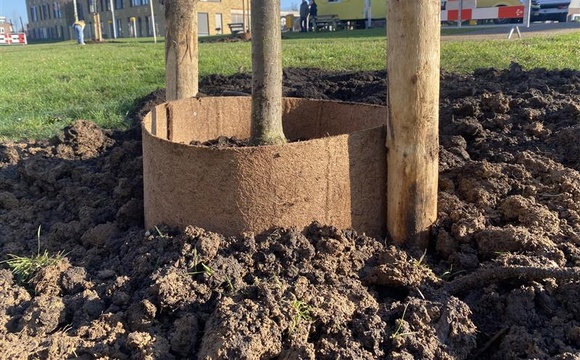
Coconut watering rims are sustainable, biodegradable solutions for tree planting, whereas conventional watering rims are made of plastic. These watering rims are produced from pure coconut fibre (coco peat), a by-product of the coconut industry derived from the coconut palm. Natural latex from the rubber tree is added for extra strength. The watering rims consist of a blend of woven coconut fibre and natural latex. This production process ensures dimensional stability, durability and a lifespan of around 3–5 years, which corresponds exactly to the aftercare period. All products are made to measure and are 100% biodegradable and cold-compostable, without chemical additives or colourants. Coconut is a natural raw material and, unlike plastic alternatives, leaves no microplastics behind. After use, the material composts and enriches the soil structure and soil life. Its slightly water-permeable structure encourages root growth beyond the root ball. The material is lightweight, flexible and easy to install.
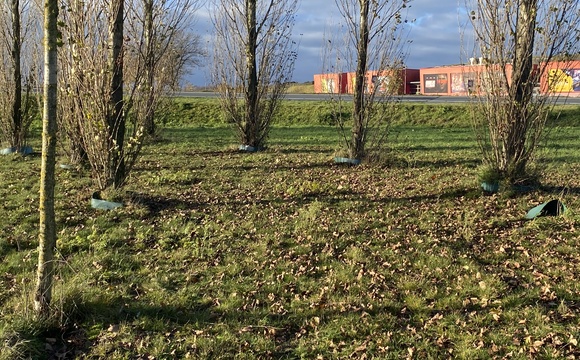
It is very important to remove the watering rims again once the trees are well established. If a watering rim is left in place for too long, it can have adverse effects on the tree. During heavy rainfall, for example, stemflow can cause the watering rim to fill with water, which may lead to stem rot and root rot at the base of the tree. The watering rim can also be damaged during mowing, making reuse impossible and leaving plastic parts behind in the planting bed. To prevent trunk damage during mowing, the installation of knee rails can be a solution.
Proper watering immediately after planting is crucial, mainly to ensure that the soil settles closely around the roots and that no air pockets can form in the soil. This is especially important when planting bare-root stock. For root-balled trees, this is slightly less critical because the roots have been lifted together with the surrounding soil. As part of aftercare, watering is particularly important during the first years after planting. During dry periods, the tree will not yet be able to find enough water on its own, because its root surface area is not yet in proportion to the size of its crown. Watering is therefore indispensable during the first years after planting.
Would you like to know more about the correct way to water? Please refer to Watering & drought.